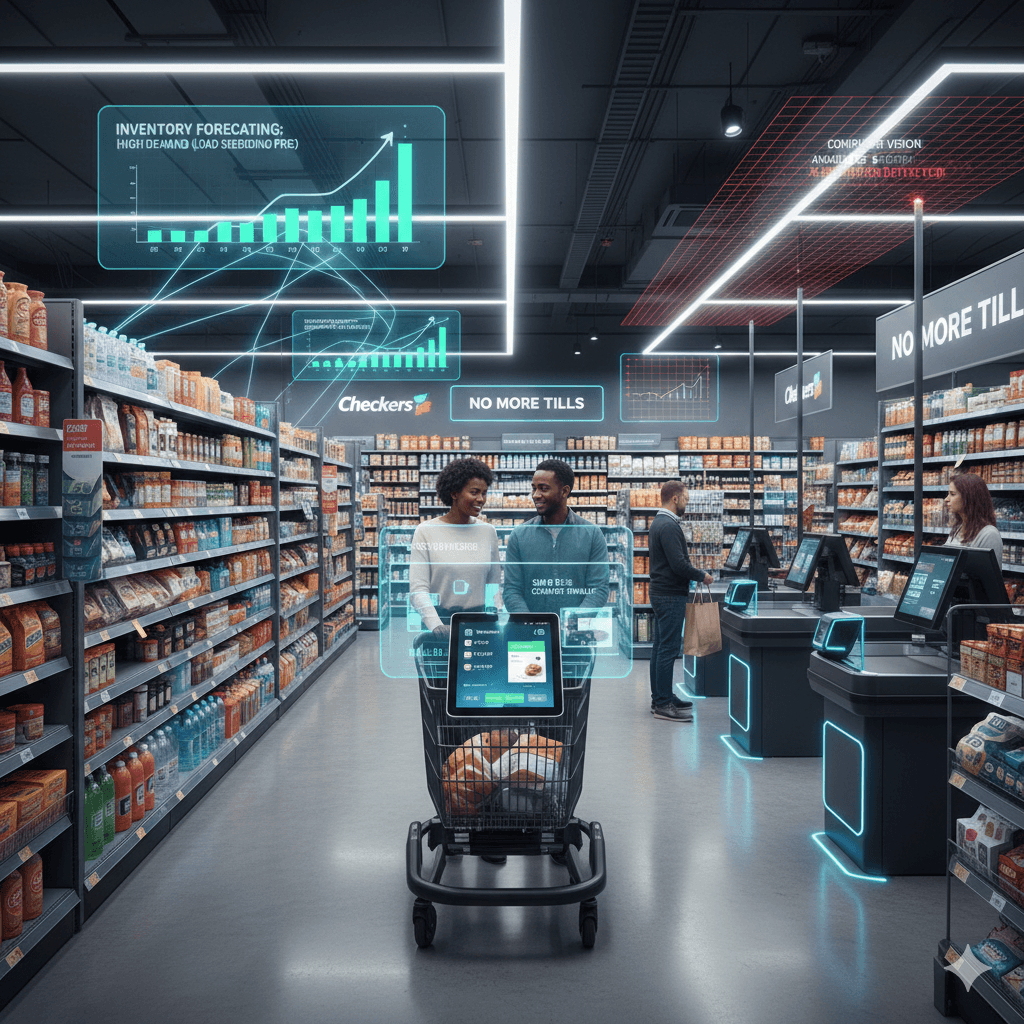
Artificial intelligence is quietly becoming one of the biggest competitive advantages in South African retail. From large chains to growing e‑commerce brands, AI is being used to forecast demand more accurately, reduce stockouts, personalise marketing, combat theft, and make checkout almost frictionless.
Below is a practical, example‑rich breakdown you can use as a blog, with a South Africa‑specific angle.
1. The Rise Of AI In South African Retail
South Africa’s AI in retail market is projected to grow from about USD 31.4 million in 2023 to nearly USD 282 million by 2032, a compound annual growth rate of over 27%. This adoption is driven by:
Rising customer expectations for fast, personalised experiences
Pressure on margins, forcing retailers to optimise stock, staff and logistics
Rapid growth in e‑commerce and omnichannel shopping, especially in Gauteng and the Western Cape
Homegrown startups in Cape Town, Johannesburg and Pretoria are building ML and edge‑computing tools for inventory automation, loyalty engines and on‑demand fulfilment, while global vendors like Microsoft and Amazon are bringing cloud‑based AI platforms into the local market.
2. AI For Demand Forecasting & Inventory Management
One of the most impactful uses of AI in South African retail is getting the right stock in the right store at the right time.
Smarter demand forecasting
Machine learning models analyse:
Historical sales per store
Promotions and price changes
Seasonality and local events
Weather and regional trends
to predict future demand on a granular level and automatically generate replenishment orders.
In real deployments, this has led to:
Lower stock days but higher on‑shelf availability. A SPAR pilot using automated ordering reduced average stock days from around 25.6 to 20.7 while improving product availability from 78% to 94.3%.
Warehouse efficiency improvements of up to about 40% and logistics‑driven delivery time cuts of around 20% in pilot sites using AI‑driven routing and automation.
Takealot, South Africa’s largest e‑commerce retailer, uses AI‑driven logistics and inventory optimisation in its dark stores and fulfilment centres to speed up deliveries and expand into underserved areas.
Real‑time inventory visibility
Computer vision, sensors and POS data feed into AI models to:
Detect out‑of‑stocks and gaps on the shelf in near real time
Track product interactions (pick‑ups, put‑backs, purchases)
Provide accurate stock counts across stores and warehouses
This allows retailers to act before a gap becomes a lost sale, and to reduce manual cycle counting.
3. AI‑Powered Personalisation & Retail Marketing
South African shoppers increasingly expect relevant, timely and personalised experiences, not generic campaigns.
Single customer view and segmentation
Retailers pull data from:
Loyalty programmes
In‑store purchases
Website and app behaviour
Email, SMS and WhatsApp engagement
and feed it into AI systems that create unified customer profiles and dynamic segments.
These models can determine:
Who is price‑sensitive versus status‑driven
Which customers respond better to SMS, email or app notifications
The best time of day to send an offer
In practice, a customer like “Thandi” might receive a 10% discount email, whereas “Sipho” gets an exclusive early access SMS for a limited‑edition drop—both powered by the same AI personalisation engine.
Impact on purchase decisions
Academic research on South African e‑commerce shows that:
Perceived relative advantage of AI personalisation (being clearly better than a generic experience) strongly influences purchase intention and loyalty.
Voluntariness of use also matters: when customers feel in control and can opt in to personalised experiences, they are more likely to engage and repurchase.
This means local retailers must pair AI personalisation with transparent data practices and clear opt‑in mechanisms to stay compliant with POPIA and build trust.
4. AI Chatbots & Virtual Assistants In South African Retail
Conversational AI is rapidly becoming the front line of customer service.
24/7 support across channels
AI‑powered chatbots and virtual assistants:
Answer FAQs on returns, delivery, stock availability and store hours
Help customers track orders or find products
Guide users through complex purchase decisions with personalised recommendations
In South Africa, AI chatbots are often deployed on WhatsApp, where consumers already spend much of their time. Telcos and financial services like MTN and Momentum have shown that WhatsApp bots can handle large volumes of queries while keeping responses personalised and fast; retail is following the same pattern.
Benefits for retailers
Reduced call centre load and wait times
Consistent service across web, app, WhatsApp and social media
Rich conversation data that feeds back into personalisation and product decisions
For smaller retailers, off‑the‑shelf AI chatbots can deliver enterprise‑grade service without hiring a full support team.
5. Computer Vision: From Shelf Monitoring To Frictionless Checkout
Computer vision (CV) is one of the most visible forms of AI in physical retail stores.
Digitising the shelf
Using cameras and CV models, retailers can:
Recognise products on shelves in real time
Detect empty spaces and mis‑placed items
Measure share of shelf versus competitors
Track shopper–shelf interactions to refine planograms
This turns store images into actionable instructions, like “go to aisle 3 and fill the empty space for brand X”, which merchandisers can act on immediately.
AI self‑checkout and autonomous shopping
AI‑based checkout systems use computer vision to identify multiple items in seconds, without scanning barcodes.
Key capabilities include:
Rapid item recognition from any angle, distinguishing between sizes and brands
Automated detection of what’s placed on a tray or in a cart
Integration with payment systems so customers can scan, pay and go
Benefits for South African retailers:
Shorter queues and higher throughput per till
Lower labour costs, allowing staff to be redeployed to customer‑facing roles
Better inventory accuracy and fewer manual errors at checkout
Local discussions around self‑checkout highlight both the opportunity to cut costs and the need to manage shrinkage and customer education as these systems roll out in South African supermarkets and convenience stores.
6. Loss Prevention, Fraud Detection & Store Security
Shrinkage is a serious issue in South African retail, making AI‑driven loss prevention especially attractive.
In‑store theft and fraud detection
Computer vision systems can:
Recognise suspicious patterns, such as concealed items, ticket switching or walk‑through thefts
Detect when items leave the shelf but are not scanned at checkout
Flag unusual patterns at self‑checkout booths for human review
By automating much of what security teams previously did manually via CCTV, retailers can reduce financial losses while still using humans for high‑judgement calls.
Payment fraud and account abuse
On the digital side, AI systems:
Analyse transaction patterns to flag card‑not‑present and identity fraud
Detect account takeover behaviours
Monitor loyalty programmes for suspicious redemptions
These tools are particularly relevant as South African retailers integrate BNPL, digital wallets and online‑to‑offline payment flows.
7. AI In Supply Chain, Logistics & Fulfilment
Behind the scenes, AI is reshaping how goods move from supplier to shelf to shopper.
Route optimisation and delivery planning
AI models ingest traffic data, delivery windows and fleet constraints to:
Optimise delivery routes
Reduce fuel and time costs
Improve on‑time delivery rates
Studies and case examples show that AI‑optimised logistics can cut delivery times by about 20%, directly improving stock availability and customer satisfaction.
Fulfilment centres and dark stores
Takealot’s use of AI‑enabled dark stores is a prime South African example: AI automates order picking, prioritises urgent orders and ensures efficient utilisation of space to speed up fulfilment.
Similar approaches are being explored by grocery and quick‑commerce players, especially in dense urban areas.
8. Dynamic Pricing & Promotion Optimisation
In a price‑sensitive market like South Africa, getting pricing right is critical.
AI systems analyse:
Competitor prices
Historical price elasticity
Real‑time demand
Stock levels and expiry dates
to recommend optimal prices and promotions that balance volume and margin.
Retailers can:
Run hyper‑local promotions by region or even store
Automate markdowns on soon‑to‑expire goods to reduce waste
Personalise offers at a customer level via coupons, app notifications and email
This kind of dynamic optimisation is far beyond what traditional spreadsheet‑based merchandisers can do manually.
9. In‑Store Experience: Layout, Heatmaps & Service
AI is increasingly used to design better physical stores.
Store layout and traffic analytics
Using cameras and sensors, AI can:
Generate heatmaps of traffic flow
Identify dead zones and high‑engagement areas
Reveal how changes to layout affect sales
Retailers use these insights to:
Place high‑margin items where shoppers linger
Optimise signage and displays
Adjust staffing to match peak times and zones, improving service without unnecessary labour costs
Bridging online and offline
Integrated AI platforms allow retailers to:
Recognise loyalty customers in store via app check‑ins or digital receipts
Serve online‑informed recommendations in‑store (“people who bought this online also bought…”)
Ensure consistency between online prices, inventory and promotions
This omnichannel experience is crucial as South African shoppers move seamlessly between web, app and physical stores.
10. Data Privacy, POPIA Compliance & Ethical AI
With powerful data comes responsibility. South African retailers must align AI initiatives with POPIA and evolving consumer expectations on privacy.
Key considerations include:
Consent and transparency: clearly explaining how customer data is used for personalisation and allowing easy opt‑out.
Data minimisation: collecting only what is needed and securing it properly.
Bias and fairness: ensuring AI models do not discriminate across income levels, locations or languages, especially in a country as diverse as South Africa.
Research emphasises that customer trust, voluntariness of use and perceived value are critical for the success of AI personalisation in the South African e‑commerce market.
Why Muze Studios Is The Right Partner For South African Retailers
Building AI solutions in-house is slow, expensive and risky. Most South African retailers lack a technical co-founder, and hiring enterprise teams costs R400K+/month with 6-12 month timelines.
Muze Studios changes this equation:
Factor | Traditional Approach | Muze Studios |
Time to MVP | 6-12 months | 6-10 weeks |
Cost (mid-market retailer) | R2-5M (6 devs × 6 months) | R400K-800K (project-based) |
Technical Leadership | Hire CTO (R200K+/month) | Fractional CTO (included) |
Risk | High: betting on one large build | Low: validate free in 2 weeks |
Scaling | Locked into one vendor | Modular, extensible architecture |
POPIA Compliance | Often overlooked | Built-in from day one |
The Muze Process For Retail
Free Idea Validation (1-2 weeks): Assess feasibility, competitive landscape and potential ROI with zero commitment.
MVP Development (6-10 weeks): Build a working prototype for one store, one category or one feature, fully integrated with your systems.
Launch & Measure (2-4 weeks): Deploy to pilot locations and collect KPI data (inventory turns, shrinkage, customer satisfaction, revenue uplift).
Scale (Month 4+): Based on validated results, roll out to additional stores or integrate with other systems.
This agile, de-risked approach is why retailers from grocery to fashion to e-commerce are turning to fractional technical partners like Muze Studios instead of hiring in-house teams or gambling on enterprise software licenses.
The Future Of AI In South African Retail
The next wave of AI in retail will feature:
Autonomous operations, where AI orchestrates supply chain, pricing and marketing with minimal human intervention
Embedded vision in smart carts, smart shelves and autonomous checkout, driven by cheaper hardware and better models
Generative AI for product descriptions, marketing content and store-level micro-campaigns
Expansion into township and rural retail with multilingual, low-bandwidth solutions
For South African retailers, the playbook is clear: start with a high‑value, low‑risk pilot (inventory, chatbots or loss prevention), measure ROI, ensure POPIA compliance, then scale.
Muze Studios is uniquely positioned to accelerate this journey: with 6-week MVPs, fractional CTO guidance and a track record of turning retail ideas into revenue-generating products, they reduce both the time and financial risk of AI adoption.
Those who move early and thoughtfully—with the right technical partner—will build differentiated, data‑driven customer experiences that are hard for competitors to copy.
If you're a South African retailer considering an AI initiative—whether inventory forecasting, personalized marketing, loss prevention or checkout automation—don't go it alone.
Schedule a free 30-minute consultation with Muze Studios to validate your idea (no commitment, no cost.
See how a 6-10 week MVP could unlock measurable ROI in your stores.
Learn how fractional technical leadership can guide your product roadmap without the salary burden.
Muze Studios: Your partner in building and growing AI software for retail. Visit themuzestudios.com.