
You run a fintech in Belfast, and your team is spending hours on work that software should handle. Someone is chasing KYC documents. Someone else is reconciling transactions by hand, copying data between systems, or pulling together a compliance report at month-end.
Business automation for Belfast fintech teams fixes this by moving repeatable, rules-based work into reliable workflows. Your people can then focus on judgement, customers, and growth. This guide covers what to automate first, how to plan it, which compliance points to watch, and how to decide between building in-house and working with a partner.
What Is Business Automation for Fintech Companies?
Business automation for fintech companies means using software to run repeatable, rules-based tasks, such as onboarding checks, reconciliation, and reporting, with little or no manual input. Done well, it reduces errors, speeds up processes, and leaves a clear audit trail for every action.
Automation isn't a single tool. It usually combines a few layers:
Workflow rules: when something happens, the system takes a defined next step, such as routing a new application to a reviewer.
System integrations: APIs that keep your CRM, payment platform, accounting software, and compliance tools in sync.
Robotic process automation (RPA): software bots that mimic clicks and keystrokes in older systems that have no API.
AI-assisted steps: tasks such as classifying documents or summarising support tickets, usually with a human reviewing the output.
Why Belfast Fintech Teams Are Prioritising Automation
Belfast has a strong mix of financial services, software engineering, and cybersecurity talent. That's a real advantage. It also means experienced engineers and compliance specialists are in demand, and hiring your way out of a growing workload is slow and expensive.
Many Belfast fintechs also serve customers and partners across the UK and beyond. That brings FCA expectations, UK GDPR obligations, and due diligence requests from larger clients. Automation helps a small team handle more volume while keeping consistent records for every decision.
Which Fintech Processes Should You Automate First?
Start with work that is high-volume, rules-based, and easy to measure. These processes deliver visible results quickly and carry less risk than anything involving complex judgement.
Process | What automation handles | What your team still owns |
|---|---|---|
Customer onboarding and KYC | Document requests, ID check triggers, status updates to the customer | Edge cases and enhanced due diligence decisions |
Transaction reconciliation | Matching records across ledgers and flagging mismatches | Investigating and resolving exceptions |
Regulatory and management reporting | Pulling data, populating templates, scheduling delivery | Review, interpretation, and sign-off |
Customer support triage | Routing tickets, suggested replies, account status lookups | Complex or sensitive complaints |
Fraud and AML alert triage | Enriching alerts with data, scoring, escalation rules | Final decisions on suspicious activity |
Finance operations | Invoice matching, approval routing, payment reminders | Policy exceptions and unusual payments |
How to Prioritise: Impact vs Effort
Plot each candidate process by how much it would improve your business and how hard it would be to implement. The matrix below shows an illustrative example. Your own placement will vary based on your systems and team.
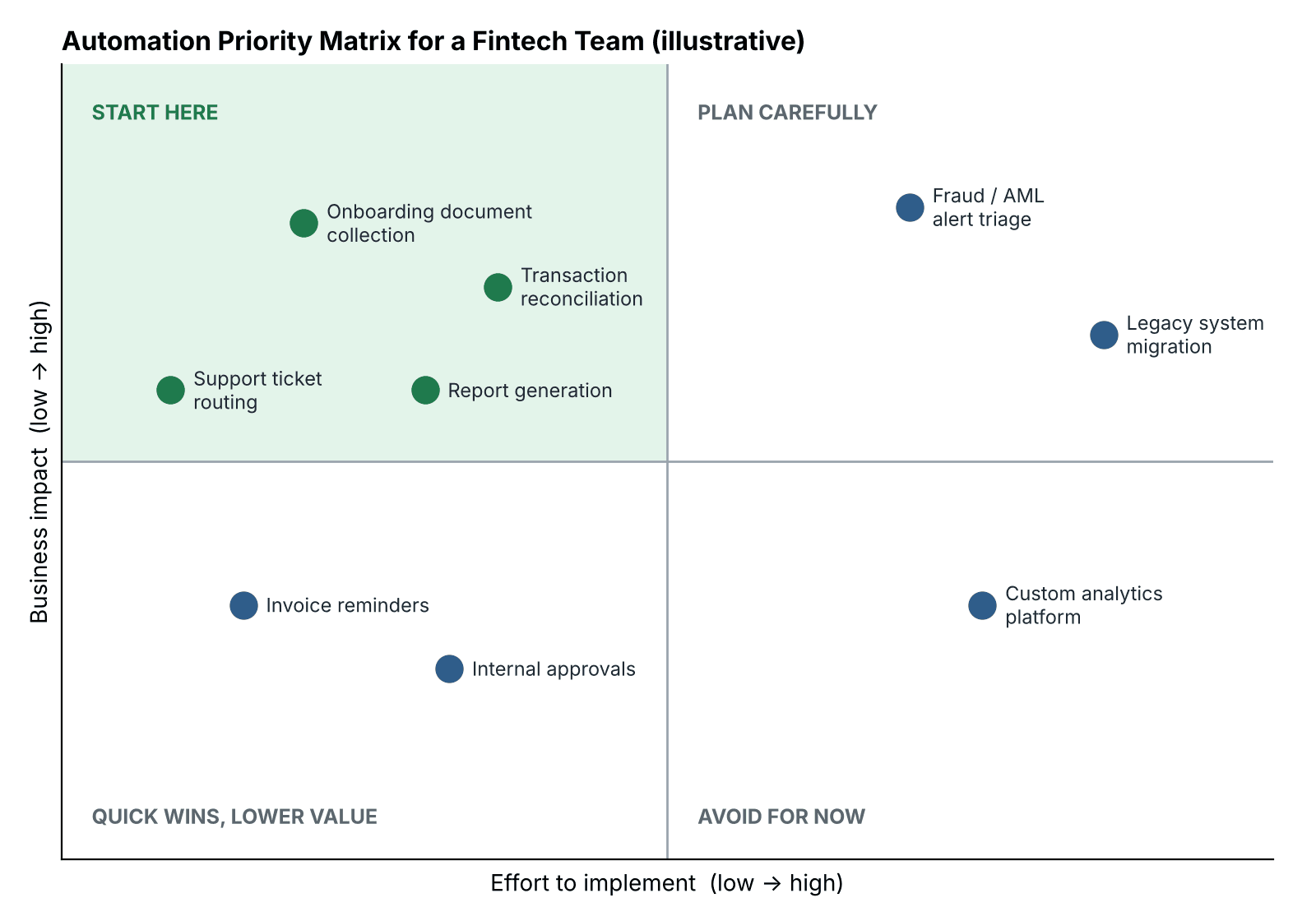
Illustrative prioritisation matrix. It is a planning aid, not benchmark data.
Processes in the top-left quadrant, such as onboarding document collection and reconciliation, are usually the best starting points. Fraud and AML triage often carries high value too, but it needs more careful design and testing before you rely on it.
How to Build a Business Automation Roadmap for a Fintech Company
Start by mapping one high-volume process, score it on impact and effort, and pilot it with human oversight. Expand only after you've measured the results. Build compliance controls into the workflow from day one rather than adding them later.
1. Map the process as it actually works
Document every step, handoff, and system involved. Talk to the people who do the work, because the real process rarely matches the written one. Fix obvious problems before you automate, or you'll simply speed up a broken process.
2. Choose a pilot with clear success metrics
Pick one process and define what success looks like. Good metrics include time per case, error rate, and the number of cases handled per person. For example: a lender might aim to cut the time from application to a complete document pack, using a before-and-after comparison.
3. Design for exceptions and human oversight
Every automated workflow needs a clear path for cases it can't handle. Decide who reviews exceptions, how quickly, and what gets logged. In regulated work, a human should stay accountable for material decisions.
4. Build, test, and document
Test with realistic data, including messy cases. Document how the workflow behaves, who owns it, and what happens when an upstream system changes. This documentation also helps during audits and client due-diligence reviews.
5. Measure, then expand
Review results after a few weeks of live use. Fix what's causing friction, then move to the next process. Small, proven steps build confidence across the team and with your compliance function.
Compliance and Security Considerations for Automated Workflows
Automation changes how work gets done, but it doesn't change your obligations. Keep these points in view during design:
Audit trails: log who or what took each action, when, and why.
Access control: give workflows and users only the permissions they need.
Data protection: apply UK GDPR principles such as data minimisation and clear retention rules.
Third-party risk: assess any vendor or tool that touches customer or transaction data.
Change management: review and test updates before they reach live workflows.
Involve your compliance officer early, and take legal advice where your obligations are unclear. This article is general guidance, not legal or regulatory advice.
Build, Buy, or Partner: Choosing How to Implement Automation
Once you know what to automate, you need to decide who builds it. Each route suits a different situation.
Option | Best for | Watch out for |
|---|---|---|
Build in-house | Teams with spare engineering capacity and highly specific processes | Ongoing maintenance and dependence on a few key people |
Off-the-shelf tools | Standard processes and a fast start | Customisation limits and usage-based costs that grow over time |
Specialist partner | Custom integrations, limited internal capacity, or tight timelines | Choosing a partner that doesn't understand your regulatory context |
If you want to move from a process map to working automation, a technology partner such as The Muze Studios can help. The team works with businesses to build software and use technology to streamline and scale their processes. That can be useful when your own engineers are focused on your core product.
Whichever route you choose, ask for clear documentation, defined ownership, and a pilot you can measure before committing to a larger programme.
Common Mistakes to Avoid
Automating a broken process. Fix the process first.
Starting with the hardest problem. Early wins build momentum and trust.
Ignoring exceptions. Edge cases will happen, so plan for them.
Leaving staff out. The people doing the work know where the friction is.
Skipping measurement. Without baseline metrics, you can't show the value.
Frequently Asked Questions
How much does business automation cost for a fintech company?
Costs depend on the number of systems involved, the complexity of the workflows, and the compliance requirements. A focused pilot costs far less than a full platform build. Ask for a scoped proposal with clear deliverables before committing.
How long does it take to implement business automation?
A well-scoped pilot can often be delivered in weeks, while broader programmes can take several months. Timelines depend on how many integrations are needed and how much testing and compliance review is required.
Is automation safe for regulated financial processes?
Yes, when it's designed with audit trails, access controls, and human review for material decisions. Your firm remains accountable for regulatory outcomes, so involve compliance from the start.
Can a small fintech team automate without a large engineering department?
Yes. Many teams start with off-the-shelf workflow tools or a specialist partner, then bring more in-house as their needs grow. The key is choosing a small, high-value pilot rather than trying to automate everything at once.
Conclusion
Business automation works best when it starts small and stays practical. Pick one high-volume, rules-based process, design it with oversight and clear records, and measure the result. Then repeat.
For Belfast fintech companies competing for talent and serving regulated markets, that approach frees up your team without adding risk. If you'd like help turning your priorities into working workflows, you can explore The Muze Studios or get in touch with the team to talk through your use case.