
Your scientists should be spending their time on science. Yet in many growing biotech, medtech and research-driven companies, the same people are chasing approvals by email, copying figures between spreadsheets and re-entering supplier details by hand.
That friction is easy to ignore when the team is small. It gets expensive after a funding round, a new hire wave or a first regulatory audit. This is the point where business automation for Oxford life sciences firms stops being a nice-to-have and starts protecting your time, your data and your momentum.
This guide explains what business automation means in a life sciences setting, which processes to automate first, and how to introduce it without putting compliance at risk.
What Is Business Automation for Life Sciences Firms?
Business automation uses software, workflows and system integrations to handle repetitive, rules-based tasks without manual effort. In life sciences, it covers the administrative and operational work around your research, such as approvals, reporting, data transfer and communication, while keeping a clear audit trail.
It's worth separating this from laboratory automation. Lab automation covers instruments, robotics and bench-level workflows. Business automation covers everything around the bench: finance, HR, procurement, quality documentation, investor updates and customer or partner communication.
Done well, it doesn't replace people. It removes the low-value tasks that slow them down and makes sure the right information reaches the right person at the right time.
Why Business Automation Matters in Oxford's Life Sciences Sector
Oxford's life sciences community is built around university spin-outs, start-ups, contract research organisations and established companies clustered across the city and nearby science parks. Many of these teams share a similar profile: lean headcount, ambitious timelines and heavy reporting demands.
That combination creates a specific set of pressures:
Small teams doing big admin. Operations, finance and HR are often handled by a handful of people, or by scientists alongside their day jobs.
Investor and grant reporting. Funders expect regular, accurate updates, and compiling them manually is slow and error-prone.
Regulated documentation. SOPs, training records and supplier files need version control and a defensible audit trail.
Data protection. Handling personal data from employees, trial participants or customers means UK GDPR obligations apply to the tools you use.
Rapid scaling. Processes that worked for five people break at twenty-five.
Automation helps with each of these, provided it's introduced in the right order.
Which Processes Should Life Sciences Teams Automate First?
Start with high-volume, rule-based tasks that carry low compliance risk, such as approvals, onboarding and enquiry handling. Then move to reporting, and only automate GxP-relevant documentation once your controls and validation approach are clear.
The table below shows where most firms find early wins and where extra care is needed.
Process | Typical manual pain | Automation approach | Compliance sensitivity |
|---|---|---|---|
Invoice and expense approvals | Chasing sign-offs by email | Approval workflows linked to accounting software | Low |
Employee and contractor onboarding | Repeated forms and access requests | Triggered checklists and account set-up | Low to medium |
Enquiries and lead follow-up | Messages sitting in shared inboxes | Forms feeding a CRM with routing and reminders | Low to medium |
Grant and investor reporting | Copying figures between spreadsheets | Scheduled data pulls into standard templates | Medium |
Supplier and purchase order management | Re-keying order data | PO workflows with synced supplier records | Medium |
SOP and document control | Version confusion and email sign-offs | Controlled workflows with versioning and audit trails | High |
Start with approvals and onboarding
These processes are repetitive, easy to map and rarely touch regulated records. A simple approval workflow can cut days of back-and-forth and gives you a clean record of who approved what and when.
Move on to reporting and enquiry handling
For example: a start-up preparing monthly investor updates might pull finance, pipeline and hiring data from three different tools. An automated report template that refreshes those figures removes hours of manual compilation and reduces transcription errors.
Treat regulated documentation with extra care
Anything that creates, changes or stores records under GxP needs a more deliberate approach. That doesn't mean you can't automate it. It means you should involve your quality lead early and decide how the system will be assessed before you build.
How to Prioritise Automation Projects
You'll probably find more candidates than you can tackle at once. A simple way to choose is to score each process on two things: the business impact of automating it, and the effort and compliance complexity involved.
The matrix below shows how that scoring typically plays out. The placement is illustrative, so your own results will vary with your tools, team size and regulatory exposure.
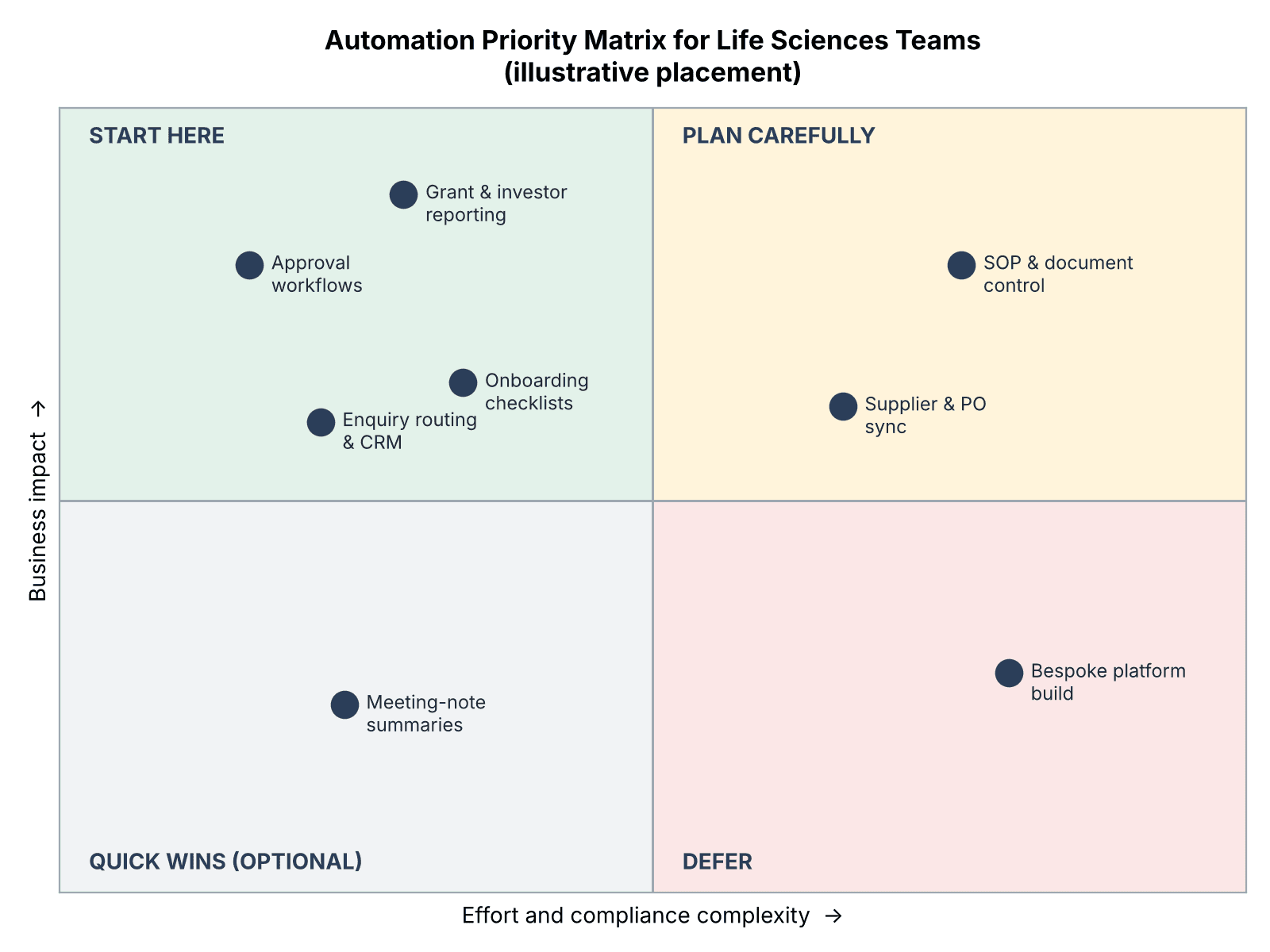
Processes in the top-left quadrant give you the quickest return with the least risk. Those in the top-right are worth doing, but they need planning, stakeholder input and often validation. Anything high-effort and low-impact can wait.
How to Implement Business Automation in a Regulated Environment
Map your current workflow, choose one well-defined process, set compliance requirements before you build, pilot with a small group, then document, train and expand. This sequence keeps risk low and builds internal confidence.
Map the process as it really works. Sit down with the people who do the task and note every step, handoff and workaround. Automating a broken process only makes the problem faster.
Pick one process with a clear start and finish. An approval route or onboarding checklist is a better first project than a company-wide overhaul.
Define compliance requirements up front. Decide who can access what, how changes are logged and where data is stored. Data integrity principles such as ALCOA+ (attributable, legible, contemporaneous, original and accurate, plus complete, consistent, enduring and available) are a useful checklist for anything touching regulated records.
Choose tools that fit your environment. Look for role-based access, audit trails, reliable integrations and a clear data residency position. If a system supports GxP activities, apply a risk-based validation approach in line with your quality system.
Pilot with a small group. Run the new workflow alongside the old one for a short period and compare results.
Document and train. Update your procedures, brief the team and make sure people know what to do when the automation fails.
Measure and expand. Track time saved, error rates and user feedback, then choose the next process from your matrix.
Build It Yourself, Buy Off-the-Shelf or Bring In a Specialist?
Most firms end up using a mix of all three. The right balance depends on your internal skills and how much time your team can spare.
Approach | Works well when | Watch out for |
|---|---|---|
Build in-house | You have technical staff with spare capacity and simple needs | Knowledge sitting with one person, and automations nobody maintains |
Buy off-the-shelf tools | Your process matches a standard workflow | Paying for features you don't use and tools that don't connect |
Work with a specialist | You need workflows mapped, tools connected and a rollout planned | Choosing a partner without relevant sector understanding |
If you'd rather not map workflows, compare tools and configure integrations on top of everything else, a specialist team such as The Muze Studios can help you move from planning to a working, documented system. The key is to look for a partner who asks about your compliance obligations before they talk about software.
Common Mistakes to Avoid
Automating too much at once. Small, measurable wins build trust faster than a big-bang rollout.
Leaving quality and compliance out of early conversations. Retrofitting controls is harder than designing them in.
Ignoring the people side. If the team doesn't understand why a workflow changed, they'll find workarounds.
Skipping documentation. An undocumented automation becomes a risk the moment its creator leaves.
Choosing tools before defining the process. Let the workflow drive the software, not the other way round.
Frequently Asked Questions
What is business automation for life sciences companies?
Business automation uses software and workflows to handle repetitive operational tasks, such as approvals, reporting and onboarding, without manual effort. In life sciences, it's designed to sit alongside quality and compliance requirements, keeping a clear record of who did what and when.
Which processes can life sciences firms automate without affecting compliance?
Low-risk administrative processes such as expense approvals, onboarding checklists, enquiry routing and internal reporting are usually the safest starting points. Anything that creates or changes regulated records should be assessed with your quality team first.
How much does business automation cost for a small biotech?
Cost depends on the number of processes, the tools involved and whether validation is needed. A single-process pilot is typically far cheaper than a multi-system rollout, so it's best to get a scoped quote after your workflows are mapped.
How long does it take to implement business automation?
A simple, single-process workflow can often go live within a few weeks. Projects involving several integrations, regulated records or formal validation take longer, so plan in phases rather than aiming for one launch date.
Do you need an Oxford-based provider for business automation?
Not necessarily, as many projects can be delivered remotely. That said, a provider who understands the Oxford life sciences ecosystem and can run workshops with your team in person may make discovery and adoption smoother.
Conclusion
Business automation works best in life sciences when it starts small, follows a clear priority order and respects your compliance obligations from day one. Map your processes, pick a low-risk, high-impact starting point, pilot it and build from there.
If you're ready to turn that approach into a working plan, you can get in touch with The Muze Studios to talk through which processes to automate first and what a sensible rollout could look like for your team.