If you run operations at an early-stage biotech in Cambridge, you know the pattern. The science moves fast, the team stays small, and the paperwork grows anyway. Purchase orders sit in inboxes. New hires wait days for system access. Board updates get stitched together from five spreadsheets the night before.
Business automation for Cambridge biotech startups fixes that kind of drag. It moves repetitive, rule-based work off your scientists’ and founders’ plates, so they can spend their time on the research and milestones investors fund.
This guide explains what to automate first, how to start without disrupting lab work, and how to keep your processes audit-ready as you grow.
What Is Business Automation for Biotech Startups?
Business automation for biotech startups means using software and connected workflows to handle repetitive administrative and operational tasks automatically, such as approvals, data entry, reporting, and onboarding. It sits around your science rather than inside your experiments, which frees your team to focus on R&D and funding milestones.
It helps to separate it from lab automation. Lab automation covers physical equipment like liquid handlers and robotic workstations. Business automation covers the operational layer around them.
Typical examples include:
Routing purchase requests to the right approver and logging them for finance
Triggering account setup, safety training, and equipment access when someone joins
Pulling data from your accounting, project, and lab systems into one reporting view
Sending reminders for grant deadlines, vendor renewals, and compliance tasks
Syncing records between tools so nobody re-types the same data twice
Why Cambridge Biotech Startups Feel the Admin Load Early
Cambridge is one of the most competitive biotech clusters in the world, and that shapes how startups operate. Teams hire quickly, share lab space and vendors, and answer to investors who expect steady progress. Every one of those pressures adds process.
A five-person company can run on chat messages and goodwill. At fifteen, that same approach breaks. Approvals get lost, reporting takes days, and your best scientists end up doing admin.
Regulatory expectations add another layer. Even before you reach the clinic, you’re building habits and records that regulators and future partners will review. Clean, traceable processes now save painful rework later.
Which Workflows Should You Automate First?
Start with workflows that repeat often, follow clear rules, and don’t touch validated GxP records. For most biotech startups, that means procurement, onboarding, reporting, and scheduling. They deliver quick time savings with low risk.
The table below compares common candidates.
Workflow | Typical pain point | What automation does | Priority |
|---|---|---|---|
Purchase approvals | Requests stall in email; finance chases details | Routes requests, applies spend rules, logs approvals | High |
New-hire onboarding | Access, training, and paperwork finish late | Triggers tasks across IT, HR, and lab safety | High |
Investor and board reporting | Data is pulled by hand from many sources | Compiles updates from connected systems | High |
Grant and milestone tracking | Deadlines and deliverables get missed | Sends reminders and tracks status centrally | Medium–High |
Reagent reordering | Stock-outs delay experiments | Flags low stock and drafts reorder requests | Medium |
Instrument-to-ELN data handoffs | Manual transcription risks errors | Moves data between systems with audit trails | Plan carefully |
Controlled document workflows | Version control and sign-off are inconsistent | Manages review and approval with records | Plan carefully |
The chart below shows how these workflows tend to compare on effort and impact. Placement is illustrative and will shift with your tools and team size.
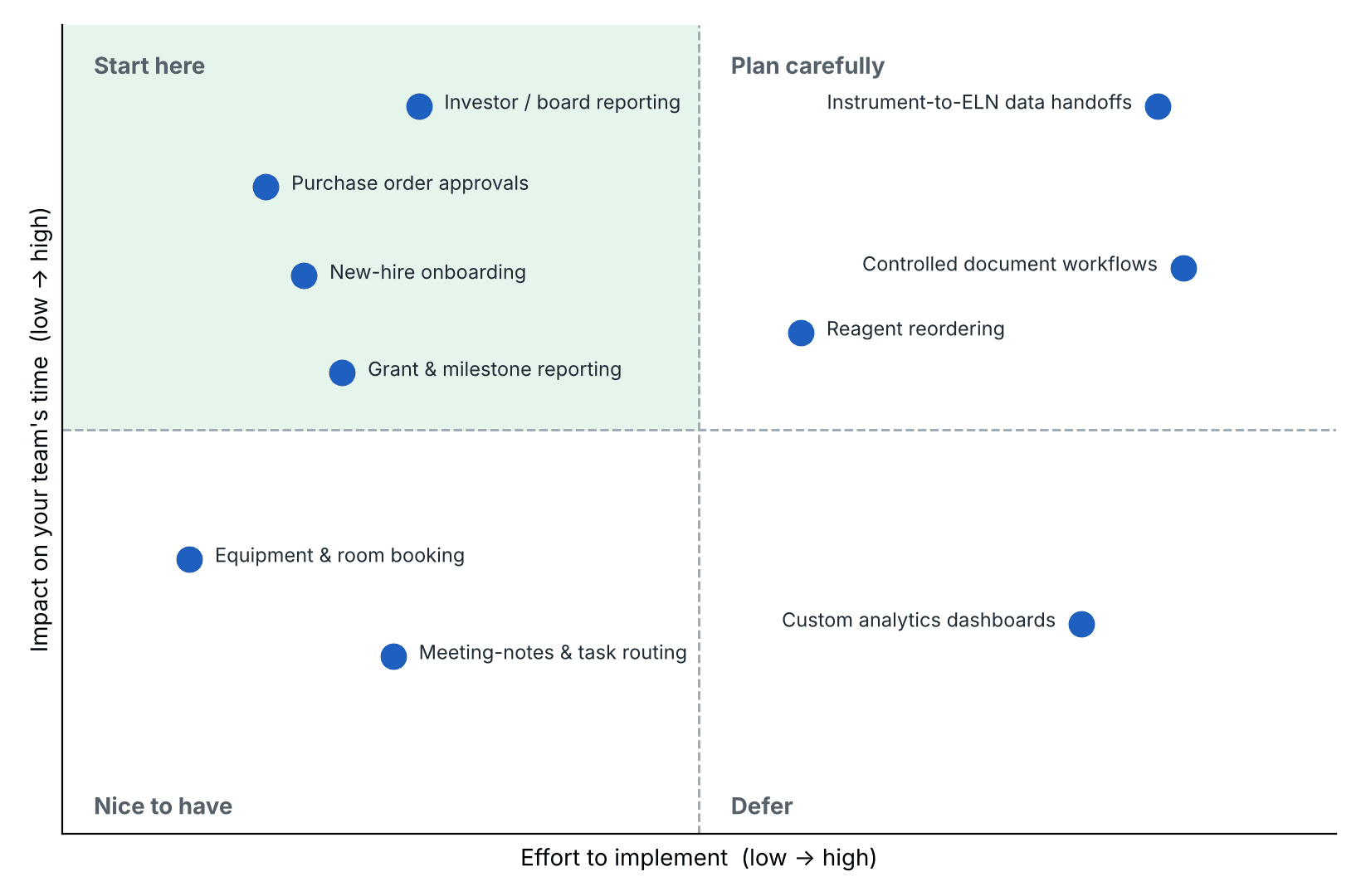
Figure 1: Illustrative effort-versus-impact view of common biotech startup workflows
A Simple Test for Any Workflow
Ask four questions about a task before you automate it:
Does it happen at least weekly?
Does it follow rules you can write down?
Does it move information between two or more tools?
Does a delay cost you time, money, or momentum?
If you answer yes to three or more, it’s a strong candidate.
How to Start Business Automation in a Biotech Startup
Start small: map one painful workflow, define what “better” looks like, pilot a fix with a few users, and expand once it works. Resist the urge to automate everything at once.
Map the current process. Write down each step, who handles it, and where it stalls. A simple flowchart is enough.
Pick one workflow. Choose something frequent and low-risk, like purchase approvals or onboarding.
Set a success measure. Track turnaround time, hours saved, or errors avoided so you can see the change.
Choose tools that fit your stack. Check how they connect to your email, chat, finance, ELN, and LIMS platforms before you commit.
Pilot with a small group. Fix friction early, while the stakes are low.
Document and train. A workflow nobody understands won’t last.
Review each quarter. Retire what no longer helps and add the next priority.
Keep Data Integrity and Compliance in View
Anything that touches regulated data needs extra care. Good records are attributable, legible, contemporaneous, original, and accurate, a set of expectations often summarized as ALCOA+. Your automated workflows should support that, not weaken it.
In practice, that means:
Role-based access so people only see and change what they should
Audit trails that record who did what and when
Clear ownership for each workflow and its documentation
Validation effort that matches the risk of the process
If electronic records support regulated submissions, rules such as FDA 21 CFR Part 11 may apply. Confirm the details with your quality lead or regulatory advisor before you automate anything in that space.
Build, Buy, or Hire a Partner?
Most startups end up combining three routes. The right mix depends on your team’s technical skills and how much time you can spare.
Route | Best for | Strengths | Watch out for |
|---|---|---|---|
Build in-house | Teams with spare technical capacity | Full control; deep knowledge of your processes | Pulls scientists and engineers away from core work |
Off-the-shelf tools | Simple, common workflows | Quick to set up; lower upfront cost | Tool sprawl; limited fit for unusual processes |
Specialist partner | Multi-system or growing operations | Faster delivery; design and rollout support | Needs clear scope and an internal owner |
Common Mistakes to Avoid
Automating a broken process. Fix the process first, or you’ll just make errors happen faster.
Starting with the biggest project. Large integrations are better after a few quick wins build trust.
Leaving scientists out. The people who live the process know where it breaks.
Skipping ownership. Every workflow needs a person responsible for keeping it current.
Adding tools without a plan. Too many disconnected apps recreate the problem you wanted to solve.
Where a Specialist Team Fits In
Plenty of startups can automate a simple approval flow on their own. The picture changes when workflows span several systems, when compliance matters, or when nobody on the team has time to design and maintain the setup.
That’s where a specialist team such as The Muze Studios can help. A partner can map your workflows, recommend tools that suit your stack, build the automations, and train your team to run them. The aim is a system your people actually use, not a pile of tools.
Frequently Asked Questions
What is the difference between business automation and lab automation?
Lab automation uses physical equipment, such as robotic handlers, to run experiments and process samples. Business automation uses software to handle the administrative and operational work around the lab, including approvals, onboarding, reporting, and system integrations.
How much does business automation cost for a Cambridge biotech startup?
Cost depends on how many workflows you automate and how many systems they connect. A single approval workflow is usually a small project, while multi-system integrations take more time and budget. A scoped quote based on your actual processes gives the most reliable number.
How long does it take to see results from business automation?
A focused pilot, such as purchase approvals or onboarding, can show results within weeks of launch. Larger integrations take longer. Tracking a baseline metric before you start makes the improvement easy to see.
Do automated workflows need to be validated in a biotech company?
It depends on what the workflow touches. Administrative processes like onboarding or scheduling usually need little formal validation, while workflows handling regulated records may require documented validation. Your quality or regulatory lead should make that call.
Can a small biotech team automate without an IT department?
Yes. Many modern tools let non-engineers build simple workflows without writing code. For anything involving multiple systems or compliance, bringing in outside help is often faster and safer than learning as you go.
Conclusion
Business automation works best when it starts small and targets the work that drains your team most. Begin with repetitive, rule-based tasks like approvals, onboarding, and reporting. Protect data integrity from day one, and add complexity only when the basics are running well.
If you’d like help choosing where to start, you can contact The Muze Studios to talk through your workflows and what a practical automation plan could look like for your team.