A guest messages your hotel on WhatsApp at 11 p.m. They want to know about airport transfers, late check-out and a table for four. Your front desk is busy, so the reply goes out the next morning. By then, they've booked somewhere else.
That gap is where business automation in Dubai's hospitality and tourism sector pays off. Guests expect fast, multilingual, always-on service, and teams that rely on spreadsheets, inbox threads and manual hand-offs struggle to keep up.
This guide explains what automation means in practice, where it delivers the most value for hotels, tour operators and restaurants, and how to start without disrupting your operation.
What Is Business Automation for Hospitality and Tourism?
Business automation for hospitality and tourism uses software to handle repetitive, rule-based tasks such as booking confirmations, guest messaging, invoicing and reporting. It frees your team for work that needs judgment and warmth. The goal isn't to replace hospitality. It's to remove the admin that gets in its way.
Automation ranges from simple rules, like "send a reminder 48 hours before arrival," to AI-assisted workflows that read an enquiry, check availability and draft a reply. Most businesses use a mix of both, connected to the systems they already run: a property management system (PMS), booking engine, CRM and payment gateway.
Why Dubai Businesses Are Prioritising Automation
Dubai's visitor economy has a few features that make manual processes expensive:
Guests expect instant replies. Travellers compare options quickly and often message through WhatsApp, Instagram or web chat instead of email.
Visitors arrive from everywhere. Multilingual communication is routine, and handling it manually is slow.
Demand swings with the season. Peak months bring surges of enquiries. Automation scales up without hiring for every peak.
Competition is intense. Hotels, holiday homes, tour operators and restaurants all fight for the same guests, so time lost to admin costs real money.
Data handling matters. Consistent, documented processes make it easier to treat guest data responsibly under UAE data protection requirements.
Where Automation Delivers the Most Value
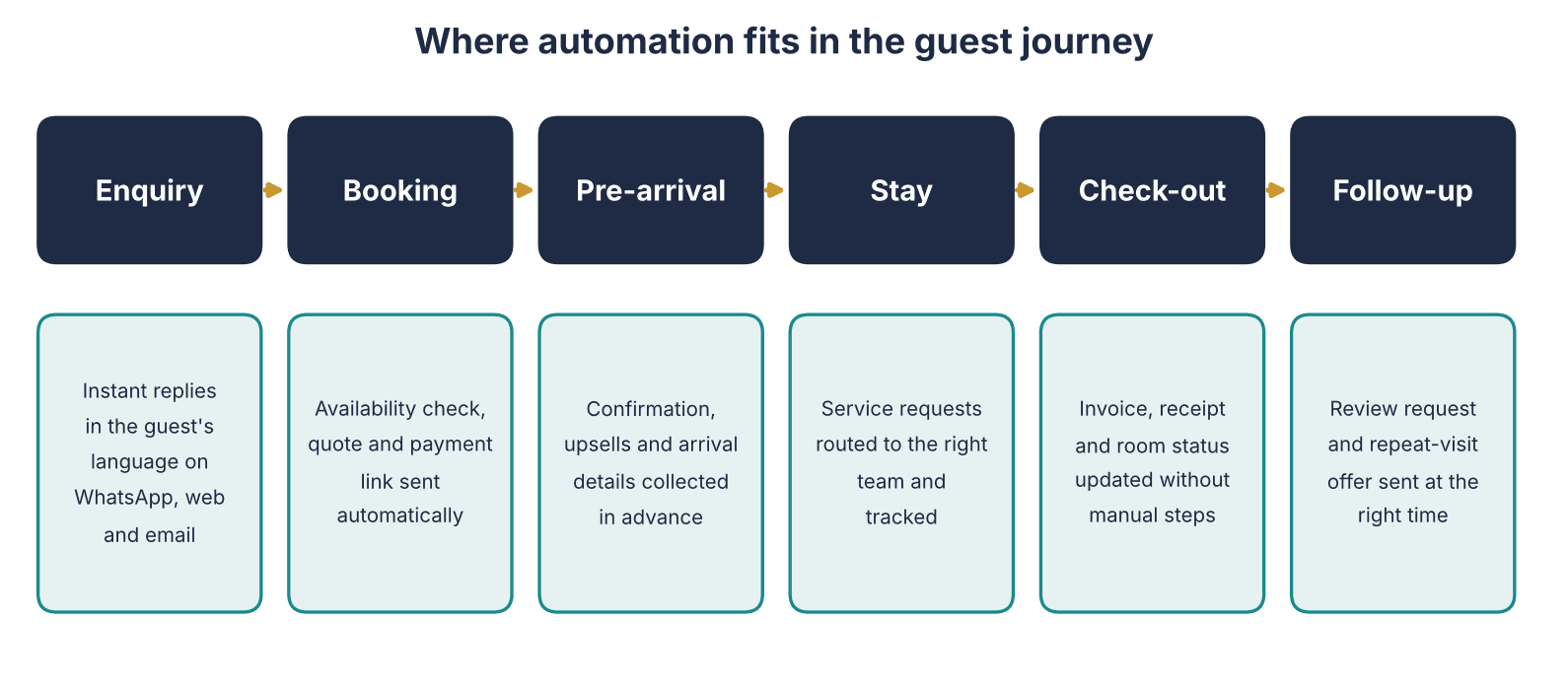
Automation works best when you follow the guest journey and ask where people wait, repeat themselves or re-enter data. The flow below shows the typical touchpoints.
Area | What you can automate | What it improves |
|---|---|---|
Guest communication | Enquiry replies, FAQs, booking confirmations, pre-arrival messages | Response time and consistency |
Reservations and revenue | Availability checks, quotes, payment links, rate rules | Conversion and fewer errors |
Front desk and operations | Digital check-in details, service-request routing, housekeeping status | Staff time and guest experience |
Finance and admin | Invoicing, reconciliation, supplier payments, licence and document reminders | Accuracy and cash-flow visibility |
Marketing and reputation | Review requests, post-stay follow-ups, segmented offers | Repeat bookings and ratings |
Reporting | Daily occupancy, revenue and channel dashboards | Faster decisions |
Guest Communication
This is usually the best place to start. Automated replies handle common questions instantly, then pass anything complex to a person with the full conversation attached.
For example: A tour operator receives enquiries through its website, Instagram and WhatsApp. An automated workflow captures each one in a single CRM, replies with available dates and sends a payment link. The sales team only steps in for custom itineraries.
Bookings and Revenue
Automation reduces double bookings, speeds up quotes and keeps rates consistent across channels. It also lets you trigger upsells, such as airport transfers or spa add-ons, at the right moment before arrival.
Back-Office Operations
Invoicing, reconciliation and reporting rarely impress guests, but they drain hours every week. Automating them cuts errors and gives managers a clear daily view of performance.
How to Start Automating Your Hospitality Business
Start with one high-volume, low-complexity process. Map it, automate it and measure the result before you expand. Choose the task your team repeats most and gets wrong most often, then prove the value there.
List repetitive tasks. Ask each team to name the three tasks they'd happily never do again.
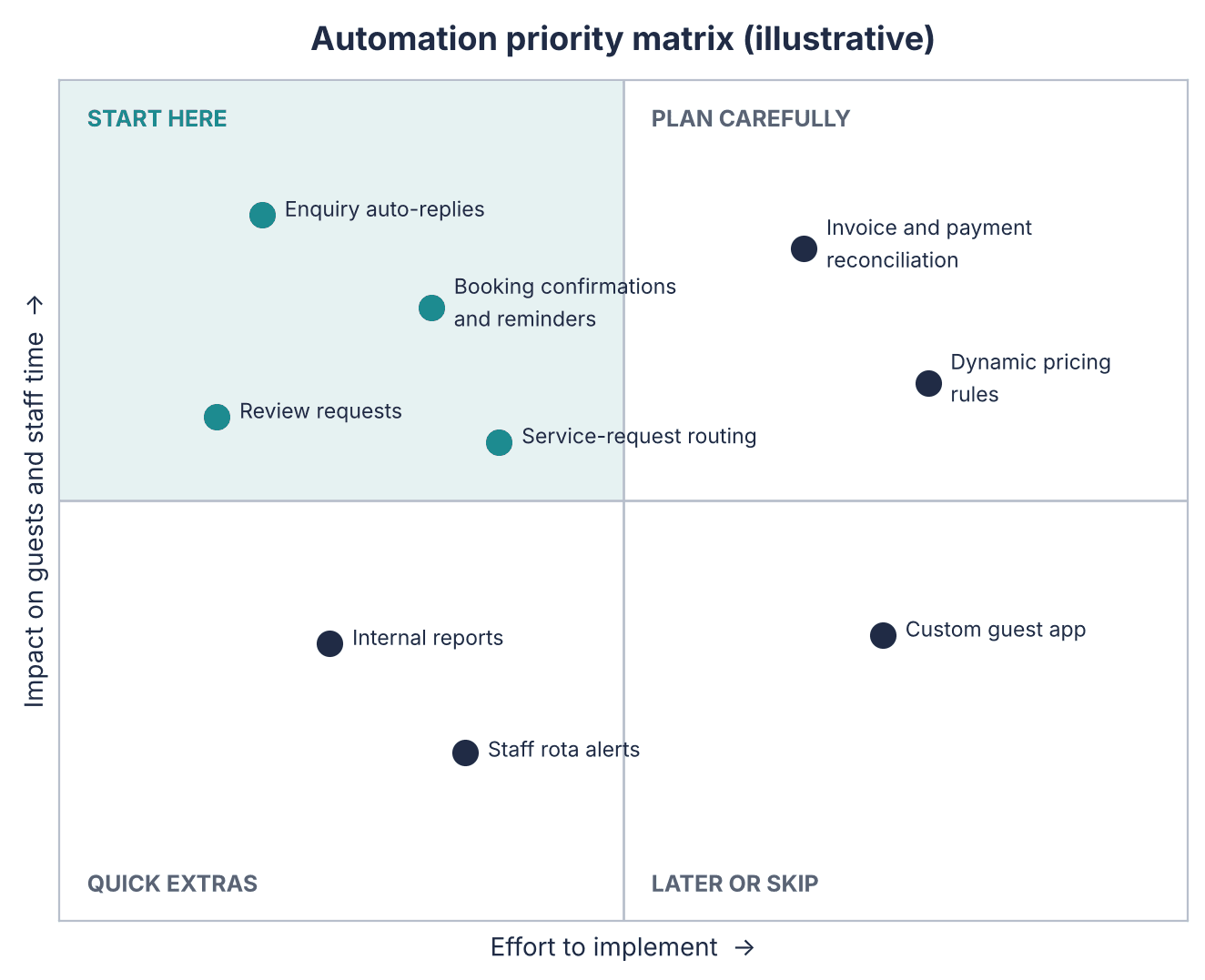
Score them. Rate each task by time spent, error risk and effort to automate. The matrix below shows how to prioritise.
How to Start Automating Your Hospitality Business Map the current process. Write down every step, hand-off and system involved.
Check your tools. See what your PMS, booking engine and CRM already support through integrations.
Pilot one workflow. Run it for several weeks with a small team and keep a human fallback.
Measure and expand. Track response time, hours saved, error rates and guest feedback before adding the next workflow.
Build, Buy or Partner? Choosing the Right Route
Option | Best for | Watch out for |
|---|---|---|
Off-the-shelf tools | Standard needs and quick setup | Limits when workflows are unusual, and tools that don't connect |
Custom-built automation | Unique processes, multiple systems, AI features | Needs clear requirements and technical expertise |
Specialist partner | Teams without in-house technical capacity | Choosing a provider that knows the technology but not your workflow |
Many Dubai hospitality businesses end up with a hybrid. When your workflows span several systems or need AI-driven steps, a specialist team can save months of trial and error. The Muze Studios designs and ships AI-powered software and intelligent automations for business owners, which makes it a relevant option once off-the-shelf tools stop fitting.
Whoever you choose, ask for a scoped pilot first rather than a full rollout.
Common Mistakes to Avoid
Automating a broken process. Fix the process first, or you'll simply scale the problem.
Removing the human touch. Keep an easy route to staff for complaints, VIP guests and complex requests.
Ignoring integrations. Disconnected tools create double entry, which is the problem you set out to solve.
Skipping staff training. Adoption fails when the team sees automation as a threat instead of a help.
Neglecting guest data. Limit access, store data securely and review your obligations under UAE data protection requirements.
Frequently Asked Questions
What is the best business automation for hotels in Dubai?
There's no single best option. Most hotels see the quickest return from automating guest messaging, booking confirmations and review requests, then move on to invoicing and reporting once those run smoothly.
How much does business automation cost for hospitality businesses?
Cost depends on scope, the number of systems involved and whether you use ready-made tools or a custom build. A single-workflow pilot costs far less than a full rollout, so starting small is a practical way to test value.
Can small tour operators and restaurants use automation?
Yes. Small teams often benefit most because every hour saved counts. Simple workflows like booking reminders, enquiry capture and review requests can run on affordable tools without a large IT team.
Will automation replace hospitality staff?
No. It handles repetitive admin so your team can focus on guest interaction, problem-solving and personal service. Keeping humans involved in complex or sensitive situations also protects service quality.
How long does it take to implement business automation?
A focused pilot, such as automated enquiry replies and confirmations, can often go live within weeks. Larger projects that connect several systems take longer, so scope and integrations are the main factors.
Conclusion
Business automation in Dubai's hospitality and tourism sector isn't about adding technology for its own sake. It's about answering guests faster, reducing errors and giving your team time for the moments that make a stay or tour memorable.
Start with one workflow, measure the result and build from there. If you'd like help scoping that first project, get in touch with The Muze Studios to talk through your processes and decide what to automate first.