
Your fintech runs on trust and speed. Customers expect a payment to land in seconds, regulators expect clean records, and investors expect growth that doesn't require a new operations hire for every thousand users.
That squeeze is why business automation Nairobi fintech founders search for has moved from "nice to have" to a survival skill. This guide explains what to automate, in what order, and how to do it without putting compliance at risk.
What Is Business Automation for a Fintech Startup?
Business automation for a fintech startup means using software to run repeatable operational tasks, such as onboarding, reconciliation, reporting and customer support, with little or no manual effort. The goal is faster, more accurate processes that scale without a matching rise in headcount.
Automation is different from your product. The product is what customers see. Automation is the machinery behind it: the workflows, integrations and checks that keep money, data and people moving correctly.
It comes in three common forms:
Rule-based workflows, where a trigger leads to a fixed action (a payment arrives, a record updates, a receipt goes out).
API integrations, where your systems exchange data directly with banks, mobile money platforms and credit bureaus.
AI-assisted automation, where software reads documents, classifies requests or flags unusual activity, then hands edge cases to a person.
Why Nairobi Fintech Startups Feel the Pressure Early
Nairobi is one of Africa's most active fintech hubs, and the reason is easy to trace. M-Pesa launched in Kenya in 2007 and taught a whole country to move money by phone. Your customers now expect that level of speed from every financial product.
That expectation creates operational weight that lean teams struggle to carry:
Many payment rails. M-Pesa, Airtel Money, bank transfers and cards each produce their own records in their own formats.
High-frequency, low-value transactions. Thousands of small payments mean thousands of lines to match and verify.
Regulatory obligations. Payment service providers and digital lenders operate under Central Bank of Kenya oversight, and any business handling personal data must follow the Data Protection Act, 2019.
Small teams. Most early-stage startups can't afford a large back office.
Manual processes survive at 100 customers. They break at 10,000.
Which Business Processes Should You Automate First?
Automate the processes that are high-volume, rule-based and error-prone first. For most Nairobi fintech startups, that means payment reconciliation, customer onboarding and KYC, and compliance reporting.
The table below compares the most common candidates.
Process | What it looks like manually | What automation does | Typical priority |
|---|---|---|---|
Payment reconciliation | Staff match M-Pesa, bank and ledger records in spreadsheets | Matches transactions automatically and flags mismatches for review | High |
Customer onboarding and KYC | Teams check IDs and forms by hand | Captures documents, runs checks and routes unclear cases to a reviewer | High |
Compliance reporting | Reports are compiled at month end under pressure | Builds reports continuously from clean, logged data | High |
Customer support triage | Agents read and sort every ticket | Categorizes queries, answers common ones and escalates the rest | Medium |
Loan and payment reminders | Staff send messages and calls manually | Sends timed reminders by SMS, WhatsApp or email | Medium |
Internal dashboards | Founders request numbers from team members | Updates key metrics automatically | Lower |
How to Rank Your Own Priorities
The chart below is an illustrative way to think about sequencing. It isn't measured data, and your own positions will differ. The idea is to start in the top-left corner: high impact for relatively low effort.
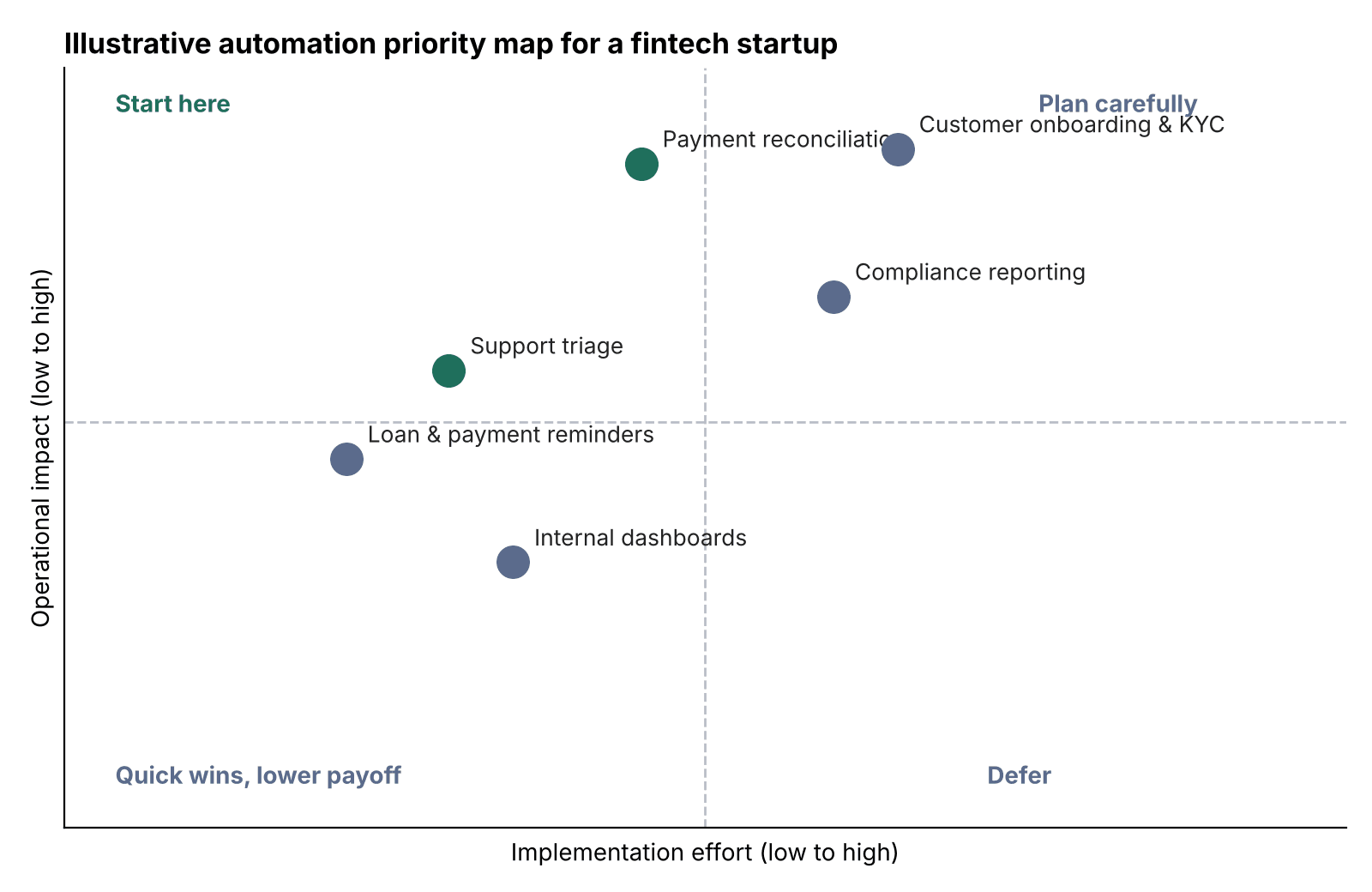
If your reconciliation takes days each month, it likely belongs in that corner. If you're still validating your product, internal dashboards can wait.
How to Automate Your Fintech Operations Step by Step
To automate fintech operations, map one process as it runs today, automate its repeatable steps through APIs, route exceptions to humans, log every action, and measure the result before expanding. Start small and prove the value before you build more.
Map the process as it actually runs. Write down every step, who does it and where it breaks. You can't automate what you haven't defined.
Choose one process. Pick the one that consumes the most staff hours or causes the most errors.
Separate rules from judgment. Anything that follows a clear rule can be automated. Anything that needs context should go to a person.
Integrate through official APIs. For M-Pesa, that means Safaricom's Daraja API rather than manual exports or fragile workarounds.
Log everything. Every automated action should leave a timestamped record you can show an auditor.
Measure and expand. Track time saved, error rates and exceptions. Use the results to choose your next process.
Keep a Human in the Loop for Edge Cases
Automation shouldn't mean unsupervised money movement. Set clear thresholds so unusual transactions, large amounts or failed identity checks pause for review. This protects customers and keeps you defensible if a regulator asks questions.
Build Security and Data Protection in From Day One
Fintech automation touches sensitive data. Limit access by role, encrypt data in transit and at rest, and collect only what you need. Retrofitting these controls later is slower and more expensive than designing them in.
A Practical Example: Automating Reconciliation
For example: Imagine a small lending startup that disburses loans and collects repayments through M-Pesa and a bank account. Each week, someone exports statements, pastes them into a spreadsheet and matches them against the loan ledger by hand.
With automation, each incoming payment triggers a lookup against the ledger. Matches post automatically. Partial payments, duplicates and unknown references land in a short exception queue for a team member to resolve.
The person who spent days matching rows now spends an hour resolving the handful that need judgment. Your books are also current every day, not just at month end.
Build, Buy or Partner? Choosing How to Automate
You have three realistic routes, and the right one depends on your team and timeline.
Off-the-shelf tools are quick to start, but they often struggle with local payment rails and unusual workflows.
Building in-house gives you control, but it pulls engineers away from your core product.
Partnering with a specialist team gets custom automation built without growing your payroll.
If you'd rather not stretch your engineers, a team like The Muze Studios, which builds AI SaaS products and intelligent automations for founders, can design and ship workflows around the way your business actually operates. The key is to choose a partner who understands your regulatory environment and can explain their approach in plain language.
Common Automation Mistakes to Avoid
Automating a broken process. Fix the process first, or you'll simply make errors faster.
Trying to automate everything at once. One working workflow beats five half-built ones.
Skipping audit trails. If you can't prove what happened, regulators and partners won't trust it.
Ignoring exceptions. Every automated flow needs a clear path for the cases it can't handle.
Forgetting the team. Train staff to supervise automation, not compete with it.
Frequently Asked Questions
How much does business automation cost for a fintech startup in Nairobi?
Cost depends on scope, integrations and how much custom work is needed. Automating a single workflow costs far less than building a connected platform. Ask for a scoped quote based on one process first.
Which fintech processes should a Nairobi startup automate first?
Start with payment reconciliation, KYC and onboarding, and compliance reporting. They involve high volume and clear rules, so they return time and accuracy quickly.
Can automated KYC and compliance workflows meet Kenyan regulations?
Yes, provided they keep accurate records, protect personal data under the Data Protection Act, 2019, and send uncertain cases to human reviewers. Regulations vary by licence type, so confirm your specific obligations with legal counsel or the relevant regulator.
How long does it take to automate a fintech workflow?
A small, well-defined workflow can often go live in a few weeks. Timelines grow with the number of integrations, the complexity of the rules and the testing your compliance needs require.
Conclusion
Business automation gives Nairobi fintech startups a way to grow without letting operations, errors and compliance work grow at the same pace. Start with one high-volume, rule-based process, build in exceptions and audit trails, and expand once you've proven the result.
If you want help turning this plan into working systems, you can contact The Muze Studios team to discuss which workflow to automate first.