If you run a shop, pharmacy, boutique, or a few outlets in Accra, you know the end-of-day routine. You count cash, match it against mobile money alerts, check the stock book, and hope the numbers agree. When they don't, you lose an hour finding out why.
Business automation for retail businesses in Accra replaces that repetitive work with systems that run in the background. This guide explains what automation actually involves, which tasks deliver the fastest payoff, and how to roll it out without disrupting sales.
What Is Business Automation for Retail?
Business automation for retail means using software to complete routine tasks, such as stock updates, sales records, payment matching, and customer messages, without manual effort. It reduces errors, saves staff time, and gives owners accurate numbers when they need them.
Automation isn't one big system you either have or don't. It's a set of small improvements. A low-stock alert that messages the manager is automation. So is a daily sales report that lands in your inbox at closing time.
The goal isn't to replace your team. It's to stop your best people from spending their day on copying figures between notebooks, spreadsheets, and phones.
Why Retailers in Accra Are Turning to Automation
Retail in Accra has its own working conditions, and good automation respects them. Several problems come up again and again:
Payments come from many places. Cash, mobile money, bank transfers, and card payments all need to be reconciled against the same sales records.
Orders arrive informally. Customers place orders through WhatsApp, Instagram, and phone calls, which makes them easy to miss or duplicate.
Stock records drift. When counts live in notebooks or separate spreadsheets, shrinkage and stock-outs stay hidden until it's too late.
Owners can't be everywhere. If you manage more than one branch, you need figures without calling each manager.
Power and connectivity aren't always stable. Systems that stop working when the internet drops can cost you more than they save.
Each of these is a process problem, not a people problem. That's why automation tends to help most where the work is repetitive and rules-based.
Retail Tasks Worth Automating First
Start with tasks that happen daily, follow clear rules, and cause real losses when they go wrong. Here's how the most common ones compare.
Task | Typical manual pain | What automation does |
|---|---|---|
Inventory tracking | Counts get out of date; stock-outs and overstock go unnoticed | Updates stock with every sale and alerts you at a set reorder level |
Payment reconciliation | Staff match cash and mobile money alerts by hand at day's end | Matches payments to sales records and flags differences |
Order handling | Orders in chat apps get lost, delayed, or double-entered | Captures orders into one list and sends confirmations |
Reporting | Owners wait days for sales summaries | Sends daily or weekly reports on sales, margins, and best sellers |
Supplier reordering | Reorders depend on someone remembering | Drafts purchase requests when stock drops below your threshold |
1. Inventory and stock alerts
Stock is usually where the money leaks. When every sale updates your inventory automatically, you see what's selling, what's sitting, and what's about to run out. Your team stops guessing.
2. Sales and mobile money reconciliation
Matching payments to sales is tedious and error-prone when done by hand. Automating it means differences surface the same day instead of at month-end. That's especially valuable when several cashiers or branches are involved.
3. Customer orders and messages
Automated order confirmations, delivery updates, and "back in stock" notices keep customers informed without tying up your staff. For example: a fashion retailer taking orders on WhatsApp can route each order into a single sheet, confirm it automatically, and update stock once it's paid.
4. Reports and tax records
Clean, automatically generated sales records make it easier to prepare invoices and returns that meet the requirements of the Ghana Revenue Authority. They also give you the numbers needed for loan applications or investor conversations.
How to Decide What to Automate First
Not every idea deserves attention now. Rank each one on two questions: how much will it improve your daily operations, and how much effort and cost does it take to set up? The matrix below shows an illustrative ranking for a typical retailer.
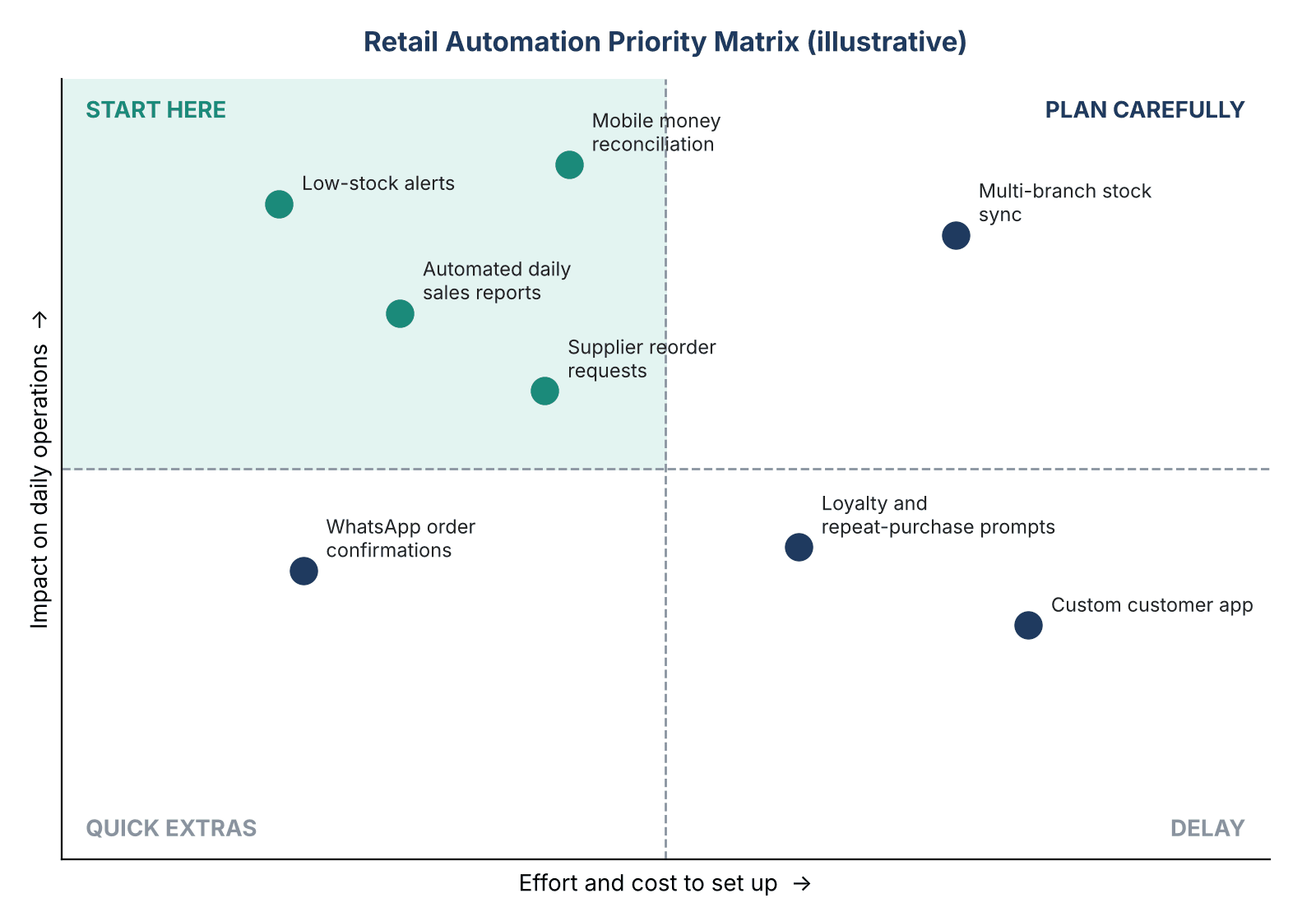
Positions are illustrative. Your own ranking will depend on your store, team, and systems.
Tasks in the top-left corner are your best first moves. They deliver visible results quickly and carry little risk. Larger projects, such as syncing stock across several branches, work better once the basics are running smoothly.
How to Implement Business Automation in a Retail Business
Start by mapping one process end to end, choose a tool that fits it, test it with a small team, and then expand. Rolling out in stages keeps sales running and builds staff confidence along the way.
Pick one painful process. Choose the task that wastes the most time or causes the most losses. Stock counts and payment matching are common starting points.
Write down how it works today. Note who does what, which tools they use, and where mistakes happen. You can't automate a process you haven't clearly described.
Set simple success measures. For example, how long end-of-day reconciliation takes, or how often an item runs out unexpectedly.
Choose a tool that works in your conditions. Look for systems that keep working through short power or internet interruptions and that support the payment methods your customers use.
Pilot with one outlet or team. Run the new process alongside the old one for a short period. Fix problems before they reach every branch.
Train your staff and review results. People adopt tools they understand. Check your measures after a few weeks, then move to the next process.
Off-the-Shelf Software, Custom Build, or a Specialist Partner?
Once you know what to automate, you have three realistic routes. The right one depends on how standard your processes are and how much time your team can give to setup.
Option | Works well when | Watch out for |
|---|---|---|
Off-the-shelf software | Your processes are fairly standard and you want a fast start | Features you'll never use, and workarounds when your process doesn't fit |
Custom-built system | Your workflow is unique or you need several tools to work together | Higher upfront effort; needs clear requirements to avoid scope creep |
Specialist partner | You'd rather not manage setup, integrations, and training yourself | Choose a team that understands retail and explains trade-offs plainly |
If you land in the second or third group, a software and technology team can shorten the path considerably. The Muze Studios works with businesses to optimise and scale their processes through technology, from websites and rebrands to custom software and AI projects. A team like that can take your manual routines and turn them into systems that fit how your shop actually runs.
Common Automation Mistakes to Avoid
Automating a broken process. If the workflow is confusing on paper, software will only make the confusion faster. Simplify first.
Trying to do everything at once. Big rollouts overwhelm staff and hide which changes helped.
Ignoring your team. Cashiers and stock clerks know where the process breaks. Involve them early.
Overlooking customer data. Systems that store customer details should handle them responsibly and in line with Ghana's Data Protection Act, 2012.
Skipping the measurement. Without a before-and-after comparison, you can't tell whether the investment paid off.
Frequently Asked Questions
What does business automation cost for a small retail business in Accra?
Costs vary widely depending on the number of outlets, the tools involved, and whether you need custom work. Ready-made software is usually priced as a monthly subscription, while custom projects are quoted based on scope. The best approach is to define one priority process first and request a quote for that.
Which retail processes should I automate first?
Begin with inventory updates, payment reconciliation, and daily sales reporting. They happen every day, follow clear rules, and directly affect your cash flow and profit. Customer messaging and loyalty features can follow once these are stable.
Do I need a stable internet connection to automate my shop?
Not always, but it helps to choose carefully. Some systems keep recording sales offline and sync when the connection returns. Ask any provider how their tool behaves during outages before you commit.
Can automation work with mobile money and WhatsApp orders?
Yes. Many systems can match mobile money payments to sales records, and orders from chat apps can be collected into a single list with automatic confirmations. The exact setup depends on the tools you use, so confirm integrations before you buy.
How long does it take to see results?
Simple automations, such as stock alerts and daily reports, can show benefits within a few weeks of going live. Larger projects like multi-branch integration take longer to set up and stabilise. Track your chosen measures from day one so you can see the difference.
Conclusion
Retail automation works best when it starts small and solves a real problem. Pick the task that costs you the most time or money, fix that first, and build from there. Within a few months, end-of-day counting and chasing orders can give way to clear numbers and calmer days.
If you'd like help turning your manual routines into a working system, you can learn more about The Muze Studios or contact the team to talk through your retail operation and where automation fits.