
A prospect messages your agency on WhatsApp at 9 p.m. asking about a three-bedroom flat in Gwarinpa. Nobody replies until the next afternoon. By then, they have viewed two other properties and signed with another agent.
If that sounds familiar, you don't have a marketing problem. You have a response and follow-up problem, and that's exactly what business automation in Abuja real estate is built to fix.
This guide explains what automation actually means for an agency, which tasks to automate first, how to roll it out step by step, and where it goes wrong. You'll finish with a clear plan you can start this month.
What Is Business Automation for Real Estate Agencies?
Business automation for real estate agencies means using software to handle repeatable tasks, such as replying to leads, booking viewings, updating listings and chasing payments, without manual effort each time. It doesn't replace your agents. It removes the admin that keeps them from showing properties and closing deals.
Think of it as a set of rules: "When this happens, do that." When a new enquiry arrives, the system replies, records the contact, and assigns an agent. When a viewing is booked, it sends a reminder the day before.
Some automation is simple and uses tools you may already own. Some is custom, such as an AI assistant trained on your listings. Most agencies need the simple kind first.
Why Abuja Agencies Feel the Pain More Than Most
Abuja's property market has its own rhythm. Demand is spread across districts like Maitama, Asokoro, Wuse, Jabi, Katampe, Lugbe and Gwarinpa. Buyers, renters and diaspora clients all compare options at once, and they expect quick answers.
Several local realities make manual processes expensive:
Enquiries arrive everywhere. WhatsApp, Instagram DMs, phone calls, property portals and your own website all feed leads in. Without a central system, some get missed.
Speed decides who wins. A prospect who hears back in five minutes remembers you. One who waits a day has usually moved on.
Listings change constantly. A property gets rented or sold, and your portals, social pages and agents still advertise it.
Viewings are hard to coordinate. Traffic, distance between districts and agents' shifting schedules turn one booking into a long chain of messages.
Rent and service charges need follow-up. Property managers lose hours each month chasing the same reminders.
None of this is a staffing failure. It's what happens when a growing agency runs on chat threads and memory.
Which Tasks Should You Automate First?
Automate the tasks that are high-impact and low-effort first: instant lead replies, central lead capture, and viewing scheduling. These protect revenue you're already paying to generate, and they're quick to set up.
The chart below ranks common agency tasks by how much they help and how hard they are to set up. These are relative judgments for a typical small to mid-sized agency, not measured figures.
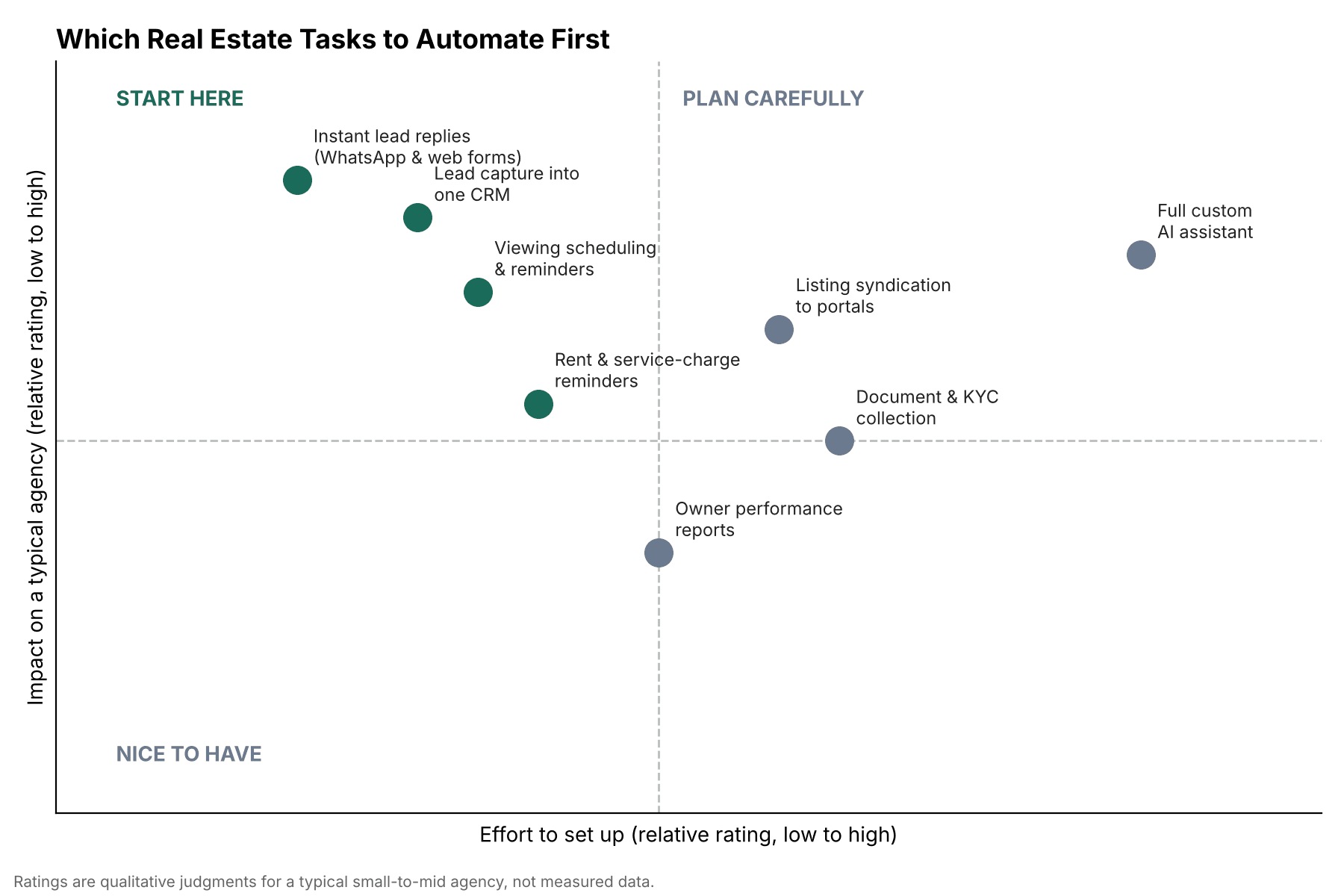
Notice where the full custom AI assistant sits. It can be valuable, but it takes more effort. Most agencies get faster results by fixing the basics first.
A quick comparison of common automations
Task | What goes wrong manually | What automation does | Effort |
|---|---|---|---|
Lead replies | Enquiries from WhatsApp, Instagram and portals sit unanswered for hours | Sends an instant first reply and asks qualifying questions | Low |
Lead capture | Contacts live in phones, notebooks and screenshots | Logs every enquiry into one CRM with its source | Low |
Viewing scheduling | Back-and-forth messages and missed appointments | Offers open slots, confirms, and sends reminders | Low to medium |
Rent and service-charge follow-up | Staff chase payments by hand, often late | Sends scheduled reminders and flags overdue accounts | Medium |
Listing syndication | The same property is re-typed on several portals | Publishes one record to several channels | Medium |
Documents and KYC | Files arrive piecemeal on chat apps | Requests, collects and files documents per client | Medium to high |
How to Start Business Automation in Your Abuja Real Estate Agency
Start by mapping how a lead travels through your agency, pick the single slowest step, and automate that one first. Then measure the result for a few weeks before adding anything else.
Map your lead journey. Write down every step from first message to signed agreement. Note who handles it and how long it takes.
Find the biggest leak. Look for where leads go quiet. For most agencies it's the first reply or the viewing follow-up.
Centralise your contacts. Choose one CRM or shared database. Every enquiry source should feed it, so nothing lives only on someone's phone.
Automate the first response. Set up an instant reply that acknowledges the enquiry, asks budget, location and timeline, and tells the prospect what happens next.
Add scheduling and reminders. Let prospects pick a viewing slot, then send confirmations and reminders to both client and agent.
Track simple numbers. Watch response time, viewings booked and leads that go cold. If those improve, you're on the right track.
Expand gradually. Move on to listing updates, payment reminders and document collection once the basics run smoothly.
A realistic example
For example: an agency in Wuse handles around 40 new enquiries a week across WhatsApp and Instagram. Two agents answer when they can, and a few messages slip through each week. After mapping the journey, the owner automates a first reply that collects budget and preferred area, then routes each lead to the right agent with a viewing link. The agents still do the selling. They just stop doing the sorting.
Build, Buy, or Partner: Choosing Your Approach
You have three realistic options, and the right one depends on how specific your workflow is.
Use ready-made tools. Off-the-shelf CRMs and messaging tools suit standard workflows and small budgets. The limit is flexibility: you adapt your process to the tool.
Hire in-house. A dedicated developer or operations person gives you control, but it's a real salary and a long hiring process.
Work with a specialist studio. This suits agencies whose process doesn't fit standard tools, or who want it built once and built properly.
If your workflow is distinctive, such as multi-channel lead routing, custom client portals or an AI assistant that answers listing questions, a specialist team can save months of trial and error. The Muze Studios is an AI-native software studio that builds custom products, AI systems and automations shaped around how a business actually works, which is the kind of support many agencies need once off-the-shelf tools stop fitting.
Common Mistakes to Avoid
Automating a broken process. If your follow-up is already inconsistent, software will make the inconsistency faster. Fix the process first.
Trying to do everything at once. Big-bang rollouts overwhelm agents. Add one automation at a time.
Removing the human touch. Automate the routine messages, but let agents handle negotiation, reassurance and relationships.
Ignoring data protection. You collect names, phone numbers and sometimes identity documents. Handle them in line with the Nigeria Data Protection Act 2023, and only collect what you need.
Skipping training. A tool nobody uses is wasted money. Show agents how it saves them time.
Frequently Asked Questions
How much does business automation cost for a real estate agency in Abuja?
Cost depends on the approach. Ready-made CRM and messaging tools usually carry a monthly subscription, while custom builds are priced by scope. Start with one high-impact workflow so you can judge the return before spending more.
Can WhatsApp be automated for property enquiries?
Yes. Businesses can use WhatsApp Business tools to send automatic greetings, quick replies and structured follow-up messages. Check the platform's current rules for automated messaging, since they change over time.
Will automation replace my real estate agents?
No. Automation handles repetitive admin like replies, reminders and data entry. Agents still do the work that wins clients: advising, negotiating and building trust.
How long does it take to set up automation for an agency?
Simple automations, such as an instant reply and lead capture, can often be running within days or a few weeks. Custom systems take longer, depending on how many channels and integrations are involved.
Which real estate tasks are best to automate first?
Begin with lead response, lead capture and viewing scheduling. They protect revenue you already generate and need the least effort to implement.
Conclusion
Business automation in Abuja real estate isn't about gadgets. It's about making sure no enquiry goes unanswered, no viewing gets forgotten and your agents spend their time on people, not paperwork.
Start small. Map your lead journey, fix the slowest step, measure the change, and build from there. If you'd like help turning that plan into a working system, you can get in touch with The Muze Studios team to talk through what your agency needs.