
A new enquiry lands on your portal listing at 9:47pm. By the time someone replies the next morning, the applicant has already booked three viewings elsewhere. If that sounds familiar, you don't have a people problem. You have a process problem.
Business automation in London real estate is about fixing exactly that. It takes repetitive tasks such as enquiry handling, viewing bookings, follow-ups and compliance paperwork off your team's plate, so agents can spend their time on the work only people can do.
This guide explains what automation means for a London agency, where it pays off most, and how to roll it out without disrupting the business.
What Is Business Automation for Real Estate Agencies?
Business automation for real estate agencies means using software to run repeatable tasks without manual effort. That includes replying to enquiries, booking viewings, chasing documents and updating records. Agents stay in control of relationships, pricing and negotiation while the system handles the routine steps.
It builds on the wider idea of business process automation, applied to the specific rhythm of lettings and sales. Most agencies already own the raw ingredients: a CRM, a website, portal feeds, email and messaging apps. Automation connects them so information moves on its own.
It isn't about replacing negotiators or property managers. It's about removing the copy-pasting, the reminder texts and the chasing that eat into their day.
Why London Agencies Feel the Pressure
London is a fast, crowded market. Applicants often contact several agencies at once, and the first useful reply frequently wins the viewing. Speed matters, but so does consistency, and both are hard to maintain by hand when enquiries arrive across portals, your website, phone and social channels.
Compliance adds another layer. Agencies handle personal data under UK GDPR, run identity checks, and carry anti-money laundering obligations on sales. Right to Rent checks apply to lettings. Missing a step is costly, and remembering every step manually is fragile.
Put simply, London agencies juggle high volume, tight response windows and heavy paperwork at the same time. That combination is where automation earns its keep.
Where Business Automation in London Real Estate Delivers the Most Value
Not every task deserves automating. Start where the work is repetitive, rule-based and frequent. The table below shows the strongest candidates.
Area | Manual pain point | Automated approach |
Lead capture | Enquiries scattered across portals, email and phone | All enquiries flow into one CRM record with source tagged |
First response | Replies depend on who's free | Instant acknowledgement with viewing options and a booking link |
Viewings | Back-and-forth scheduling and no-shows | Self-booking, confirmations and reminders by email or text |
Follow-up | Leads go cold after a viewing | Timed feedback requests and next-step prompts |
Onboarding and compliance | Chasing IDs, proof of funds and signatures | Digital forms, automatic reminders and a status checklist |
Landlord and vendor updates | Manual progress emails | Scheduled reports pulled from live data |
Lead capture and first response
This is usually the highest-impact starting point. When every enquiry is logged automatically and answered within minutes, you stop losing applicants to slower competitors. Your team then picks up warm conversations instead of cold ones.
Viewings and follow-up
For example: an applicant enquires about a two-bed flat. The system sends a booking link, confirms the slot, reminds them the day before, and asks for feedback afterwards. The negotiator only steps in for the viewing itself.
Onboarding, compliance and reporting
Automated checklists make sure no document or check is missed, and they create a clear audit trail. Regular landlord and vendor updates can also be generated from live records, which cuts the weekly reporting scramble.
How to Automate Your Real Estate Agency Step by Step
Start by mapping your current process, then automate one high-volume workflow at a time. Choose a tool that connects to your existing CRM, test it with a small group, and measure response time and workload before expanding.
Map the journey. Write down every step from first enquiry to completion, and note who does each one and how long it takes.
Find the repetitive steps. Highlight tasks that follow the same rules every time. Those are your candidates.
Pick one workflow. Enquiry response is a common first choice because the results are easy to see.
Check your data and consent. Make sure contact details are accurate and that your messaging respects UK GDPR and marketing preferences.
Choose tools that integrate. Favour software that connects to your CRM and portals rather than creating another silo.
Pilot, measure, adjust. Run it with one team or branch, track response times, booking rates and staff hours, then refine.
Expand gradually. Add follow-up, onboarding and reporting once the first workflow runs smoothly.
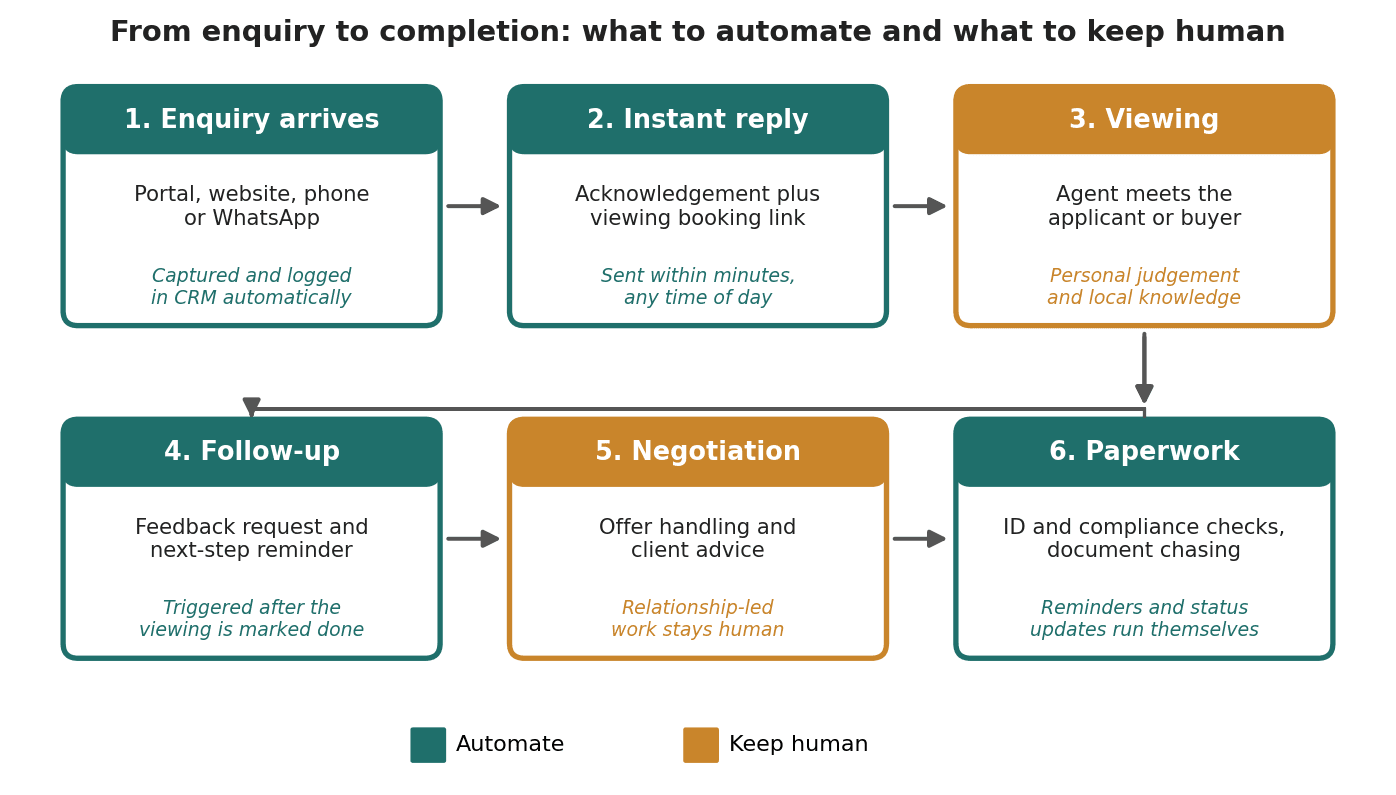
The chart below shows how the pieces fit together across a typical journey, and which steps are best left to people.
Common Mistakes to Avoid
Automating a broken process. Fix the workflow first. Automation speeds up whatever you feed it, good or bad.
Sounding robotic. Automated messages should read like your agency, with clear handover to a person when a conversation needs one.
Buying too many tools. Overlapping software creates duplicate data and confusion.
Skipping the team. Agents adopt what they help shape. Involve them early and ask what slows them down.
Ignoring data protection. Store and use personal data in line with UK GDPR, and keep consent records tidy.
Should You Build It Yourself or Get Help?
Small, simple automations, such as an auto-reply or a reminder text, are often easy to set up in-house. Things get harder when you need several systems talking to each other, consistent branding across every message, and workflows that fit how your agency actually operates.
That's where an outside specialist can shorten the learning curve. If you'd like help deciding what to automate first and how to put it into practice, The Muze Studios can work with you to plan and implement a system that suits your agency.
You can also get in touch with the Muze Studios team to talk through your current process and where the biggest time savings are likely to be.
Frequently Asked Questions
What is business automation for real estate agencies?
It's the use of software to handle repeatable agency tasks such as enquiry replies, viewing bookings and document chasing. Agents keep control of client relationships while routine steps run automatically.
Which tasks should a London estate agency automate first?
Start with lead capture and first response, since speed has the biggest effect on conversions. Viewing scheduling and reminders are usually the next best candidates.
Is real estate automation compliant with UK GDPR?
It can be, provided you collect and use personal data lawfully, honour consent and marketing preferences, and choose tools that store data securely. Review your privacy notice and data-sharing arrangements before you switch anything on.
How long does it take to set up business automation for an agency?
A single workflow, such as enquiry response, can often be live within a few weeks. A wider rollout across lettings, sales and compliance takes longer, so most agencies phase it in over several months.
Will automation replace estate agents?
No. It removes repetitive admin, but negotiation, valuation, local knowledge and client trust still depend on people. Automation gives agents more time for that work.
Conclusion
Business automation in London real estate works best when it's targeted. Start with the repetitive, time-sensitive tasks, prove the results on one workflow, then build outward while keeping people at the centre of negotiation and client care.
If you're ready to look at your own process, The Muze Studios can help you identify the right starting point, or you can contact the team to begin the conversation.