
If your firm still moves work between teams using spreadsheets, shared inboxes and manual checks, you already know the cost. Onboarding takes longer than it should. Reports get rebuilt every month. Skilled people spend their days re-keying data instead of advising clients.
That's why business automation in Leeds for financial services is getting serious attention from advisers, lenders, insurers, accountancies and fintechs. Done well, it removes repetitive work, tightens compliance and gives your team time back.
This guide explains what business automation involves, where it pays off most, how to choose your first project and how to roll it out safely under UK regulation.
What Is Business Automation for Financial Services?
Business automation for financial services means using software to run repeatable, rules-based tasks with little manual effort. Typical examples include collecting client data, running identity checks, generating reports and routing approvals. It reduces errors, creates audit trails and frees staff for work that needs judgement.
It isn't one product. Most firms combine several approaches:
Workflow automation: moves a case from step to step and assigns tasks automatically.
Robotic process automation (RPA): software "bots" that copy how a person clicks and types in existing systems. You can read more about robotic process automation if the term is new to you.
Document processing: extracts data from forms, statements and ID documents.
System integrations: connects your CRM, accounting, case management and compliance tools so data flows once.
AI-assisted triage: sorts and summarises incoming requests, with a person reviewing the output.
Why Leeds Financial Services Firms Are Investing in Automation
Leeds is one of the UK's largest financial and professional services centres outside London. That concentration gives you a deep talent pool, but it also means firms compete hard for good people.
Four pressures keep coming up:
Growing compliance workload. Anti-money laundering checks, UK GDPR and the FCA's Consumer Duty all demand evidence, not just good intentions.
Higher client expectations. People expect fast, digital onboarding and clear updates.
Margin pressure. Manual processing costs the same whether volumes rise or fall.
Hiring and retention. Admin-heavy roles are hard to fill and easy to lose.
Automation doesn't replace your team. It removes the low-value tasks that make those roles frustrating, so people can focus on advice, relationships and complex cases.
Where Business Automation Delivers the Most Value
The best candidates share three traits: they're repetitive, they follow clear rules and they touch several systems. These five areas usually fit.
1. Client onboarding and KYC
Onboarding often involves chasing documents, re-entering the same details and running checks by hand. Automation can capture data once, trigger identity and AML checks, flag missing items and update your CRM without anyone retyping.
For example: a Leeds mortgage broker could send applicants a secure link, extract details from their uploaded payslips and pass a complete, checked file to an adviser the same day.
2. Compliance reporting and audit trails
Compliance teams spend hours pulling data from different systems into one report. Automated reporting gathers the data on a schedule and keeps a time-stamped record of every action. When an auditor or regulator asks what happened on a case, you can show them.
3. Loan, mortgage and claims processing
Rules-based steps such as eligibility checks, completeness checks and routing can run automatically. Decisions that affect customers still need human oversight, but your underwriters and handlers see cleaner, better-prepared cases.
4. Finance operations and reconciliation
Matching invoices, payments and ledger entries is a classic automation task. It cuts keying errors and shortens month-end close.
5. Client communication and periodic reviews
Review reminders, document requests and status updates can go out automatically, triggered by dates or events in your systems. Nothing slips, and clients hear from you without anyone having to remember.
Here's how these compare at a glance:
Process | Typical manual pain | What automation changes |
Client onboarding | Repeated data entry, document chasing, delays | Single data capture, automatic checks, instant status updates |
Compliance reporting | Manual data pulls, version confusion | Scheduled reports with a full audit trail |
Loan or claims processing | Inconsistent triage, slow handoffs | Rules-based routing, cleaner files for decision-makers |
Reconciliation | Line-by-line matching, month-end rush | Automatic matching, exceptions only for review |
Client reviews | Missed dates, ad hoc follow-ups | Triggered reminders and tracked responses |
How to Decide What to Automate First
Don't start with the biggest, most exciting project. Start with one that's valuable and low-risk, so you prove the approach and build confidence.
Score each candidate process on two questions. How much time, risk or cost does it create today? And how complex is it to automate, based on the number of systems, exceptions and approvals involved? The chart below shows how common processes might sit. Your own placement will differ.
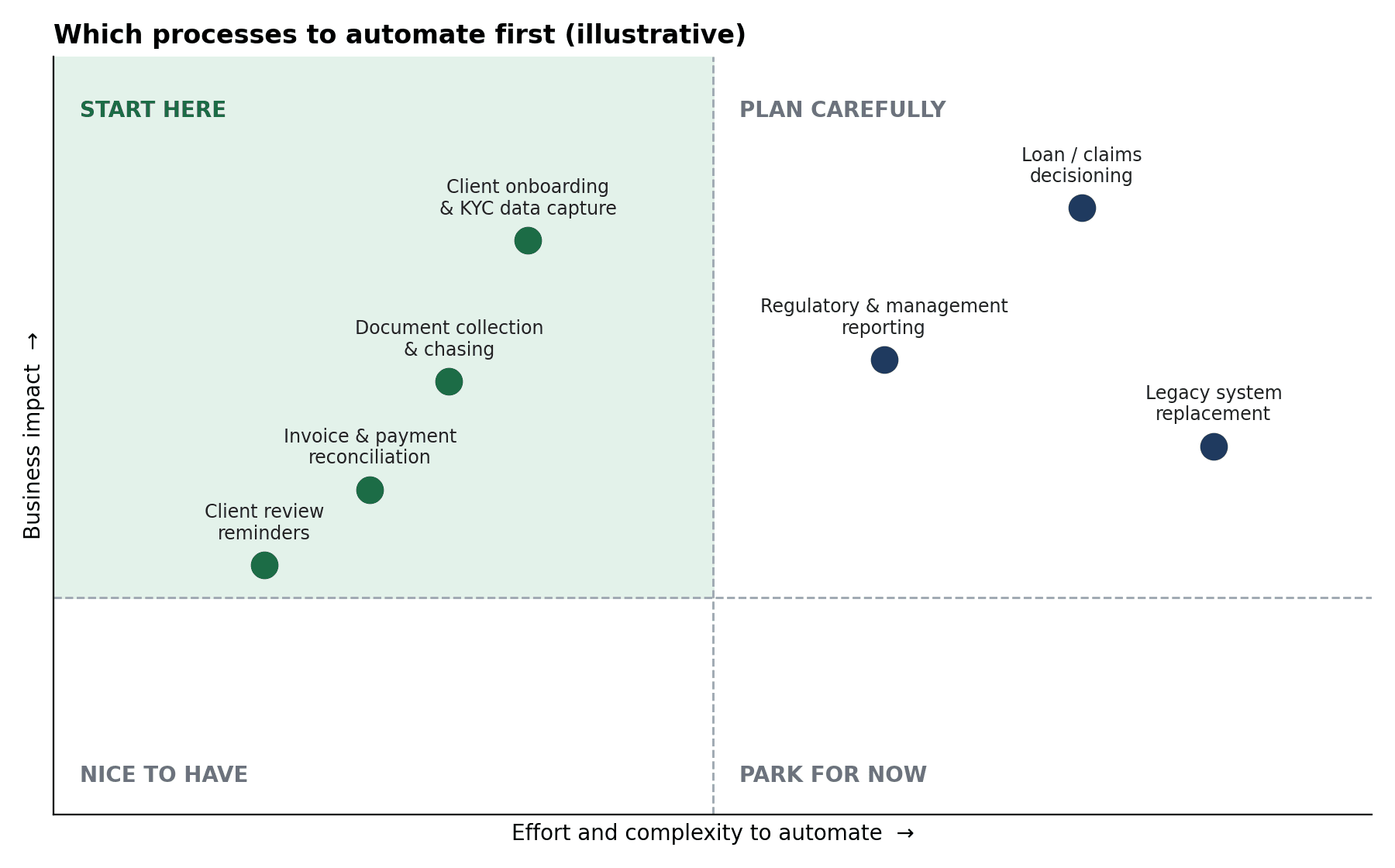
Figure 1: Illustrative impact-versus-effort view of common financial services processes.
Processes in the top-left corner give you the strongest first project: high impact, manageable effort. Save the top-right items for when you have a track record and a clear plan.
How to Implement Business Automation in a Financial Services Firm
Start by mapping one process as it actually runs, measure how long it takes today, then automate a small pilot with proper controls. Review the results, fix the exceptions and only then expand to the next process. This staged approach limits risk and keeps compliance in view throughout.
Map the real process. Talk to the people who do the work. The documented procedure and the daily reality are rarely identical.
Measure the baseline. Record time per case, error rates, rework and turnaround. You'll need these numbers to prove the benefit later.
Define rules and exceptions. Decide what happens when data is missing, a check fails or a case doesn't fit the pattern. Exceptions should route to a named person.
Pilot one process. Run it with a small group or a limited set of cases before going firm-wide.
Build in controls. Add approvals, access permissions, logging and clear ownership from day one rather than bolting them on later.
Train, review and refine. Check results against your baseline after a few weeks, gather feedback from users and adjust before you scale.
Compliance and Security Considerations
In financial services, how you automate matters as much as what you automate. Your firm remains responsible for outcomes, whether a person or a system carried out the step. Keep these points in view:
Auditability. Every automated action should leave a record showing what happened, when and why.
Human oversight. Keep a person in the loop for decisions that materially affect customers, and make it easy for them to override.
Data protection. Know where client data is stored and processed, who can access it and how long you keep it, in line with UK GDPR.
Supplier due diligence. Check the security practices and resilience of any tool or partner that handles sensitive data.
Change control. Test updates before they go live so a rule change doesn't quietly alter outcomes.
Involve your compliance officer or MLRO early. It's far easier to design controls in than to retrofit them after a review.
Build, Buy or Partner: Which Route Suits Your Firm?
There are three common routes. The right one depends on your internal skills, budget and how specific your processes are.
Route | Best for | Strengths | Watch-outs |
Off-the-shelf tools | Standard tasks such as e-signature or basic workflows | Quick to start, lower upfront cost | Can be rigid; may not connect to your existing systems |
In-house build | Firms with a dedicated technical team | Full control and deep process knowledge | Needs ongoing maintenance, and key-person risk is real |
Specialist partner | Firms with complex, multi-system processes and limited internal capacity | Design, build and support from people who do it daily | Requires careful partner selection and clear scoping |
Common Mistakes to Avoid
Automating a broken process. Fix the process first, or you'll just make mistakes faster.
Choosing tools before defining the problem. Start with the outcome you want.
Ignoring exceptions. Real cases are messy, and exception handling decides whether automation helps or creates extra work.
Skipping change management. Staff who don't understand or trust the new process will work around it.
Leaving no one in charge. Every automated process needs an owner who monitors it and keeps it current.
Working With a Leeds Automation Partner
Many financial services firms have the process knowledge but not the time or technical capacity to design, build and maintain automation. That's where a specialist partner earns its place.
A team such as The Muze Studios can help you map your workflows, pick the right first project and turn it into a working system. Before you commit to any partner, ask:
How will you learn how our processes actually work?
How do you handle audit trails, access controls and client data?
What happens when a rule changes or something breaks?
Who owns the automation once it's built?
Clear answers to those four questions tell you far more than a polished sales deck.
If you'd like to talk through which processes to automate first, you can contact The Muze Studios team to discuss your situation.
Frequently Asked Questions
How much does business automation cost for a financial services firm?
Cost depends on scope. A single workflow automation costs far less than a multi-system integration with document processing and reporting. Ask for a scoped pilot with a fixed price so you can judge the return before committing to more.
Which financial services processes should I automate first?
Start with high-volume, rules-based tasks that cause delays or errors, such as client onboarding data capture, document chasing and reconciliation. These deliver visible results with relatively low risk.
Is business automation compliant with FCA expectations?
Automation is not prohibited, but your firm remains accountable for outcomes. Build in audit trails, human oversight for customer-affecting decisions and clear ownership, and involve your compliance team from the start.
How long does it take to implement business automation?
A focused pilot on one process can often be live within weeks, depending on system access and the number of exceptions. Larger programmes that connect several systems take longer and are best delivered in stages.
Why work with a local partner for business automation in Leeds?
A local partner can run in-person workshops with your team and understands the regional financial services market. It isn't essential, but it can make process mapping and training easier.
Conclusion
Business automation in Leeds for financial services isn't about replacing people. It's about removing repetitive work, strengthening compliance and giving your team room to do what only humans can do.
Pick one process, map it honestly, measure it, pilot it with strong controls and build from there. If you'd like a specialist to help you scope that first step, visit The Muze Studios or get in touch to start the conversation.

