
If your team still re-keys client details into three systems, chases signatures by email and builds compliance reports by hand, you're not alone. Many firms across Sandton, Rosebank and Midrand run on that kind of manual work, and it slows everything down.
Business automation in Johannesburg for financial services means handing those repetitive, rule-based tasks to software so your people can focus on advice, judgement and client relationships. This guide explains what automation covers, which processes to tackle first, how POPIA and FICA fit in, and how to roll it out without disrupting your operations.
What Is Business Automation for Financial Services?
Business automation uses software, workflows and system integrations to complete repetitive, rule-based tasks with little or no manual effort. In financial services, that usually covers client onboarding, document handling, data capture, reporting and compliance checks. The goal is faster turnaround, fewer errors and a clear audit trail.
Automation isn't one tool. It's a set of building blocks you combine based on the process you want to fix:
Workflow automation: moves a task from person to person (or system to system) based on rules, with reminders and approvals built in.
Robotic process automation (RPA): software "bots" that copy data between systems the way a person would. You can read a general overview of robotic process automation if the term is new to you.
Document processing: reads, classifies and files ID documents, bank statements, policy schedules and forms.
Integrations: connect your CRM, policy admin, accounting and communication tools so data is captured once and shared everywhere.
Dashboards and reporting: pull live data into one view so managers don't wait for month-end spreadsheets.
Why Business Automation in Johannesburg Matters for Financial Services Firms
Johannesburg is South Africa's financial hub. Banks, insurers, asset managers, brokers, medical schemes and a growing fintech scene all compete here for the same clients and the same skilled people. That competition creates a few clear pressures:
Regulatory workload. FICA, POPIA, FAIS and the expectations of the FSCA and the Prudential Authority all demand accurate records and timely reporting.
Client expectations. Clients compare you with digital-first competitors. Waiting days for an onboarding or a quote costs you business.
Cost and capacity. Manual work scales with headcount. Automation lets you grow volumes without growing admin at the same rate.
Operational resilience. Load shedding and connectivity interruptions make cloud-based, well-designed systems more attractive than processes that depend on one person at one desk.
None of these problems disappears with software alone. But repetitive work is where firms lose the most time, and it's also where automation is easiest to prove.
Which Financial Services Processes Can You Automate?
Most firms can automate more than they expect. The table below shows where automation tends to help most.
Process | What automation does | What you gain |
|---|---|---|
Client onboarding and KYC | Collects documents through a secure portal, pre-fills forms and flags missing or mismatched items | Shorter onboarding and fewer rejected files |
Document management | Classifies, names and files documents against the right client record | Less searching and a cleaner audit trail |
Claims and loan applications | Routes each application to the correct approver and tracks every step | Faster decisions and clear accountability |
Compliance reporting | Pulls data from source systems on a schedule and prepares standard reports | Consistent, up-to-date reporting |
Renewals and client communication | Sends reminders, renewal notices and status updates automatically | Fewer follow-up calls and fewer lapses |
Reconciliation and data entry | Matches records across systems and highlights exceptions only | Fewer manual errors |
For example: an independent financial advisory firm onboards a new client. Today, an admin collects an ID and proof of address by email, retypes the details into three systems, and a compliance officer checks every file by hand. With automation, the client uploads documents through a secure portal, the details are captured once and passed to each system, and the compliance officer only reviews files where something is missing or doesn't match.
How to Start Business Automation in Your Financial Services Firm
Start with one high-volume, rule-based process. Map how it works today, measure it, automate it in a small pilot, then expand once the results are clear. Starting small limits risk and builds trust inside your team.
Map the current process. Write down every step, handover and system involved. Include the workarounds people use. They show you where the real friction sits.
Choose your first process. Pick something frequent, predictable and painful. The matrix below helps you sort candidates.
Set a baseline. Record how long the process takes, how often errors occur and how many people touch it. Without a baseline, you can't prove the return.
Choose your approach. Decide whether off-the-shelf tools, a custom build or a mix will fit your systems and budget (more on this below).
Run a pilot. Automate the process for one team or product line. Keep a person in the loop for the first few weeks.
Train, refine and scale. Fix what the pilot reveals, train the wider team, then move to the next process.
How to Choose Your First Process
Plot each candidate by business impact and by the effort needed to automate it. Processes with high impact and low effort are your best first projects. Complex, exception-heavy processes are better left until your team has some wins behind it.
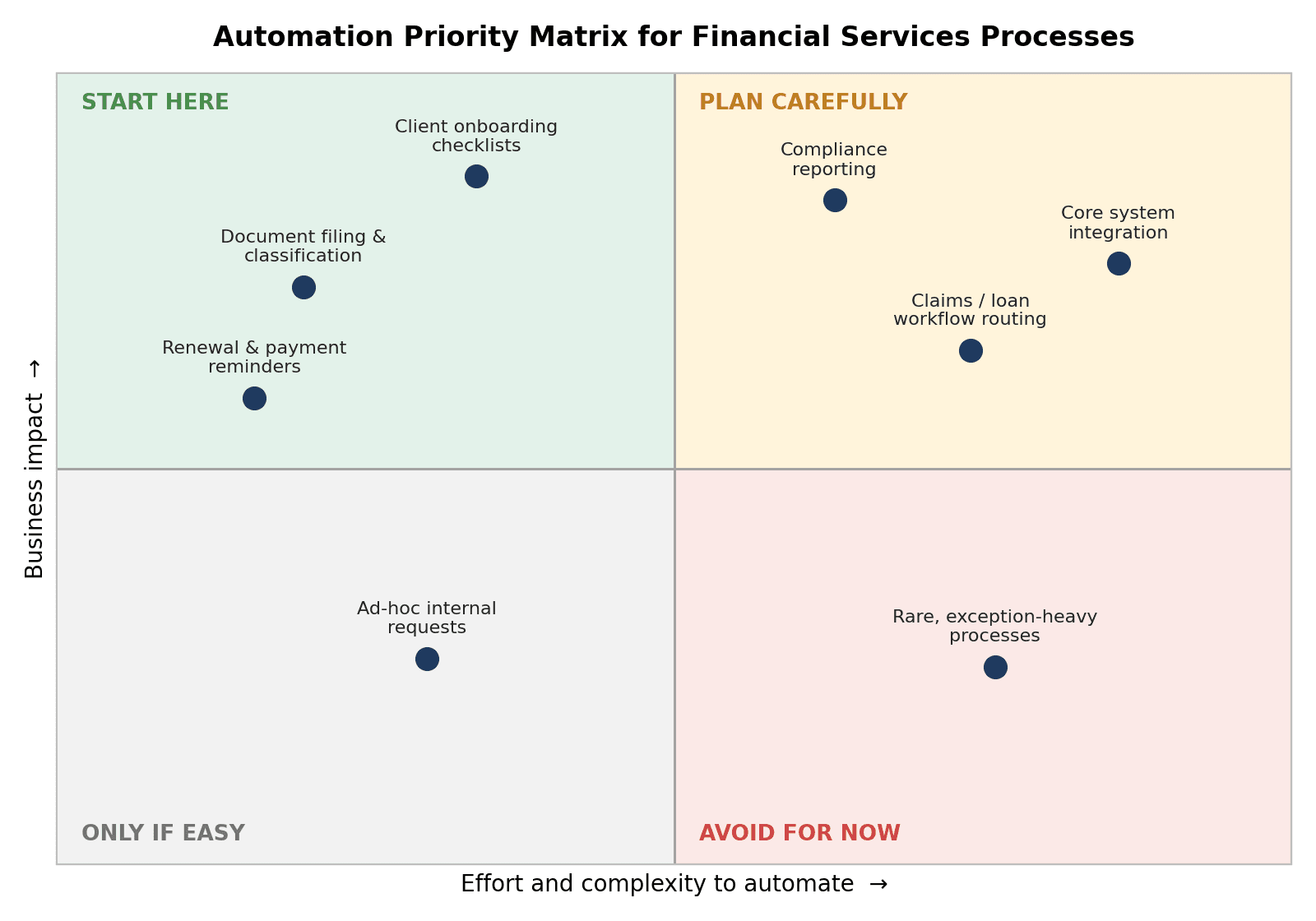
Illustrative placement. Your own volumes, systems and risk profile will shift where each process sits.
Compliance and Data Security Come First
Financial services firms handle some of the most sensitive personal information there is. Automation has to make your compliance position stronger, not weaker. Before you automate any process, check these points:
POPIA: know what personal information the system processes, who can access it, where it's stored and whether any of it leaves South Africa.
FICA: make sure the system captures customer due diligence information and keeps records in a way you can retrieve and show to a regulator.
Access control and audit logs: every action should be traceable to a person or a system, with role-based access.
Vendor agreements: if a provider handles personal information on your behalf, put the right contractual safeguards in place.
Human review: keep a person in the loop for high-risk decisions, such as flagged client profiles or declined applications.
Your compliance officer or legal adviser should sign off on the design before launch. It's far cheaper to build controls in at the start than to retrofit them later.
Should You Build, Buy or Partner?
There's no single right answer. The best option depends on your systems, your in-house skills and how unusual your processes are.
Option | Strengths | Watch-outs |
|---|---|---|
Off-the-shelf tools | Quick to start, predictable pricing, proven features | May not fit your processes or connect cleanly to older systems |
Custom-built solution | Fits your exact workflow and systems | Higher upfront cost, longer timelines and ongoing maintenance |
Partner-led hybrid | Combines proven tools with tailored workflows and outside expertise | Needs a partner who understands your regulatory environment |
If you'd rather not map, select and implement everything on your own, a specialist team such as The Muze Studios can help you turn a process problem into a working, documented automation. The best partners start by understanding your process and your compliance obligations, not by selling you a tool.
Common Automation Mistakes to Avoid
Automating a broken process. Automation makes a bad process faster. Fix the process first.
Skipping change management. If your team doesn't understand why the change is happening, they'll find ways around it.
Ignoring legacy systems. Older platforms often limit what you can connect. Check this early.
Having no owner. Every automated process needs someone responsible for monitoring and improving it.
Measuring nothing. If you don't track results, you can't justify the next project.
How Do You Measure Success?
Pick a few measures before you start and track them after launch:
Turnaround time from request to completion
Error and rework rates
Staff hours spent on the process each month
Compliance exceptions and audit findings
Client satisfaction and drop-off during onboarding
Review these monthly for the first quarter. They'll show you what's working, and they make a strong case for automating the next process.
Frequently Asked Questions
What is business automation for financial services?
It's the use of software to handle repetitive, rule-based tasks such as onboarding, document filing, reporting and client reminders. It reduces manual effort and errors while keeping a full record of every action.
Is business automation compliant with POPIA and FICA?
It can be, if it's designed with those laws in mind. That means secure storage, controlled access, audit trails and proper record-keeping. Always have your compliance officer or legal adviser review the design.
How much does business automation cost for a Johannesburg financial services firm?
Cost depends on the number of processes, the systems involved and whether you use off-the-shelf tools or custom work. A small pilot on one process is usually the most affordable way to start and to measure the return.
How long does it take to implement business automation?
A focused pilot on a single process can often be scoped and launched in weeks rather than months. Larger projects that touch several systems or need heavy integration take longer.
Which process should a financial services firm automate first?
Start with a process that's high in volume, rule-based and easy to measure, such as client onboarding checklists or document filing. These deliver visible results quickly and carry less risk than complex, exception-heavy processes.
Conclusion
Business automation for financial services in Johannesburg works best when you treat it as a series of small, measurable wins rather than one big overhaul. Map a process, fix it, automate it, build in your compliance controls, and measure what changes. Then repeat.
If you're ready to move from planning to execution, contact The Muze Studios to talk through your processes and find the right first step.