Your head office team probably spends more time chasing data than using it. Production figures sit in one system, safety records in another, and supplier documents in someone's inbox. By the time the monthly pack reaches leadership, it's already out of date.
That's the daily reality behind most requests for business automation in Johannesburg mining. Many of South Africa's mining and resources companies run their corporate, finance and compliance functions from Johannesburg. Those teams handle a heavy load of repetitive, rule-based work.
This guide explains what business automation means for mining and resources, where it pays off fastest, and how to roll it out without disrupting operations. You'll also get a simple way to decide what to automate first.
Why Johannesburg Mining Businesses Are Turning to Automation
Mining is one of the most heavily regulated industries in the country. Companies report against health and safety requirements, environmental authorisations, Social and Labour Plan commitments and B-BBEE obligations. Each report draws on data from several teams, sites and systems.
Add the usual pressures of the sector: tight margins, volatile commodity prices, large contractor networks and sites spread across provinces. Manual processes struggle under that weight.
The result is familiar to most operations and finance leaders:
Reports assembled by hand from spreadsheets and email attachments
Approvals that stall because someone is underground, travelling or on leave
Duplicate data entry across finance, procurement and HR systems
Compliance evidence that's hard to find when an auditor asks for it
Automation tackles these gaps by letting software handle the repeatable steps, so your people can focus on judgement and decisions.
What Is Business Automation in Mining and Resources?
Business automation uses software to carry out repetitive, rule-based tasks such as data capture, approvals, notifications and reporting without manual effort. In mining, it applies to corporate and support processes like compliance, procurement, finance and HR. It's separate from operational technology, such as autonomous haulage or sensor-driven plant control.
The distinction matters. Many leaders hear "automation" and think of driverless trucks or remote-operated equipment. Those sit on the production side. Business automation works on the paperwork, workflows and data movement that surround production.
Operational automation | Business automation | |
|---|---|---|
Where it applies | Pit, plant and underground operations | Head office, finance, HR, procurement, compliance |
Typical examples | Autonomous haulage, remote monitoring, process control | Approval workflows, automated reports, document routing, invoice matching |
Main goal | Safer, more consistent production | Faster, more accurate and auditable administration |
Who owns it | Operations and engineering | Finance, corporate services, IT and compliance |
Where Business Automation Delivers the Most Value
You don't need to automate everything. The best candidates are processes that are high-volume, rule-based and painful when they go wrong. Here are the areas where mining businesses commonly see the quickest returns.
Compliance and Regulatory Reporting
Compliance work is repetitive and deadline-driven, which makes it ideal for automation. Scheduled workflows can pull data from source systems, populate standard templates, route them for sign-off and store the final version with a clear audit trail.
For example: A monthly safety and environmental report that takes a team three days to compile can be assembled automatically from site data. Reviewers then spend their time checking the numbers instead of building the document.
Procurement and Supplier Onboarding
Mining groups work with large supplier and contractor networks. Onboarding each one means collecting registration documents, tax and B-BBEE certificates, and safety credentials. An automated workflow can request documents, flag expired certificates and alert the right approver.
Contractor Invoicing and Payments
Matching invoices to purchase orders and delivery confirmations is slow when done manually. Automation can compare the documents, flag mismatches and send clean invoices straight to approval, which reduces payment delays and disputes.
Employee Onboarding and Training Records
Site access often depends on medicals, induction records and competency certificates. Automated tracking can remind employees and managers before a certificate expires, so nobody arrives on site with lapsed credentials.
Management Reporting
Leaders need a reliable view of cost, production and compliance status. Automated data consolidation brings figures from different systems into one reporting layer, so you're not reconciling spreadsheets before every meeting.
How to Decide What to Automate First
A simple way to prioritise is to score each process on two things: how much impact automation would have, and how easy it would be to implement. The matrix below shows an illustrative example for a mining business. Your own positions will differ based on your systems and team.
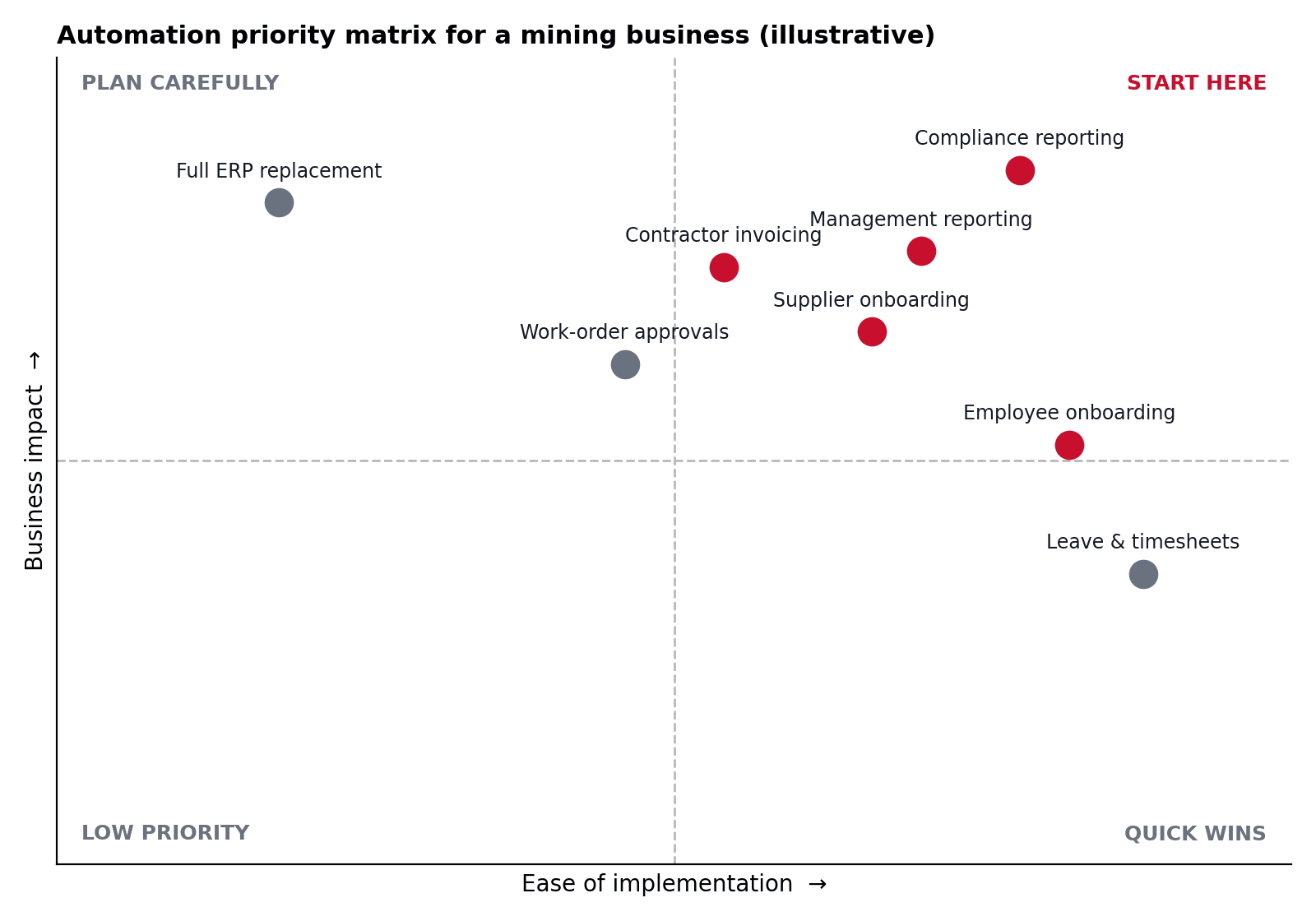
Figure 1: Illustrative prioritisation of mining business processes. Not based on measured data.
Processes in the top-right corner give you the best return for the least disruption. Large projects, like replacing a full ERP platform, can be valuable but need careful planning. They rarely make a good first step.
How to Implement Business Automation in a Mining Business
Start with one well-defined process, map how it works today, automate the most repetitive steps, then measure the result before expanding. A small, visible win builds trust across teams and shows what's possible. Rolling out everything at once usually creates resistance and avoidable risk.
Map the current process. Write down every step, handoff and system involved. You'll often find steps nobody realised existed.
Pick a pilot. Choose a process with clear rules, a known owner and measurable pain, such as report turnaround time or invoice errors.
Clean up before you automate. Automating a broken process only makes mistakes happen faster. Remove unnecessary steps first.
Involve the people who do the work. Finance clerks, HR coordinators and compliance officers know where the real problems are.
Build in controls. Mining processes need approvals, access limits and audit trails. Design these in from day one.
Measure and expand. Track time saved, error rates and turnaround. Use those results to choose the next process.
Common Mistakes to Avoid
Starting with the tool, not the problem. Define the process pain first, then choose the technology.
Ignoring data quality. Automation depends on accurate inputs. Inconsistent supplier names or missing fields will break workflows.
Overlooking security and data access. Mining companies hold commercially sensitive and personal information. Access rules need to be clear.
Skipping change management. People need to know what's changing and why. Training and clear communication matter as much as the software.
Treating automation as a one-off project. Regulations, systems and sites change. Plan for ongoing review and improvement.
Build In-House, Buy Software, or Work With a Specialist?
Once you've chosen a process, you'll need to decide how to deliver it. Each route has trade-offs.
Option | Works well when | Watch out for |
|---|---|---|
In-house team | You have internal developers and a stable pipeline of projects | Limited capacity, slow delivery and key-person risk |
Off-the-shelf software | Your process is standard and the tool fits closely | Rigid workflows and add-on costs to adapt it to mining needs |
Specialist partner | You need tailored workflows, integration across systems or faster delivery | Choosing a partner who doesn't understand your industry's compliance demands |
If you want to move from process mapping to working automation without stretching your internal team, a specialist partner such as The Muze Studios can help you scope, design and implement the right workflows for your business. Whoever you choose, look for clear communication, a practical approach to pilots and a willingness to understand how your sites and head office actually operate.
Frequently Asked Questions
What is business automation for mining companies?
It's the use of software to handle repetitive administrative and corporate tasks, such as compliance reporting, procurement approvals and invoice processing. It sits alongside, but is separate from, automation of physical mining operations.
Which mining processes should be automated first?
Start with high-volume, rule-based tasks that cause delays or errors, such as compliance reporting, supplier onboarding and invoice matching. These typically offer clear results with limited disruption to operations.
How long does it take to implement business automation?
A focused pilot on a single process can often be delivered in weeks, depending on complexity and system integration. Broader programmes that cover several departments take longer and are best rolled out in phases.
Does business automation replace jobs in mining?
Its main purpose is to remove repetitive manual work, not people. Teams usually shift their time from data capture and chasing approvals to analysis, oversight and decision-making.
Conclusion
Business automation in Johannesburg mining isn't about replacing your people or overhauling your whole technology stack. It's about taking repetitive, rule-based admin off their plates so they can focus on work that moves the business forward.
Start small, pick a process with clear pain, measure the result and build from there. Compliance reporting, supplier onboarding and invoicing are good places to begin.
If you'd like to talk through which processes to tackle first, you can contact The Muze Studios to discuss your needs and explore a practical starting point.